
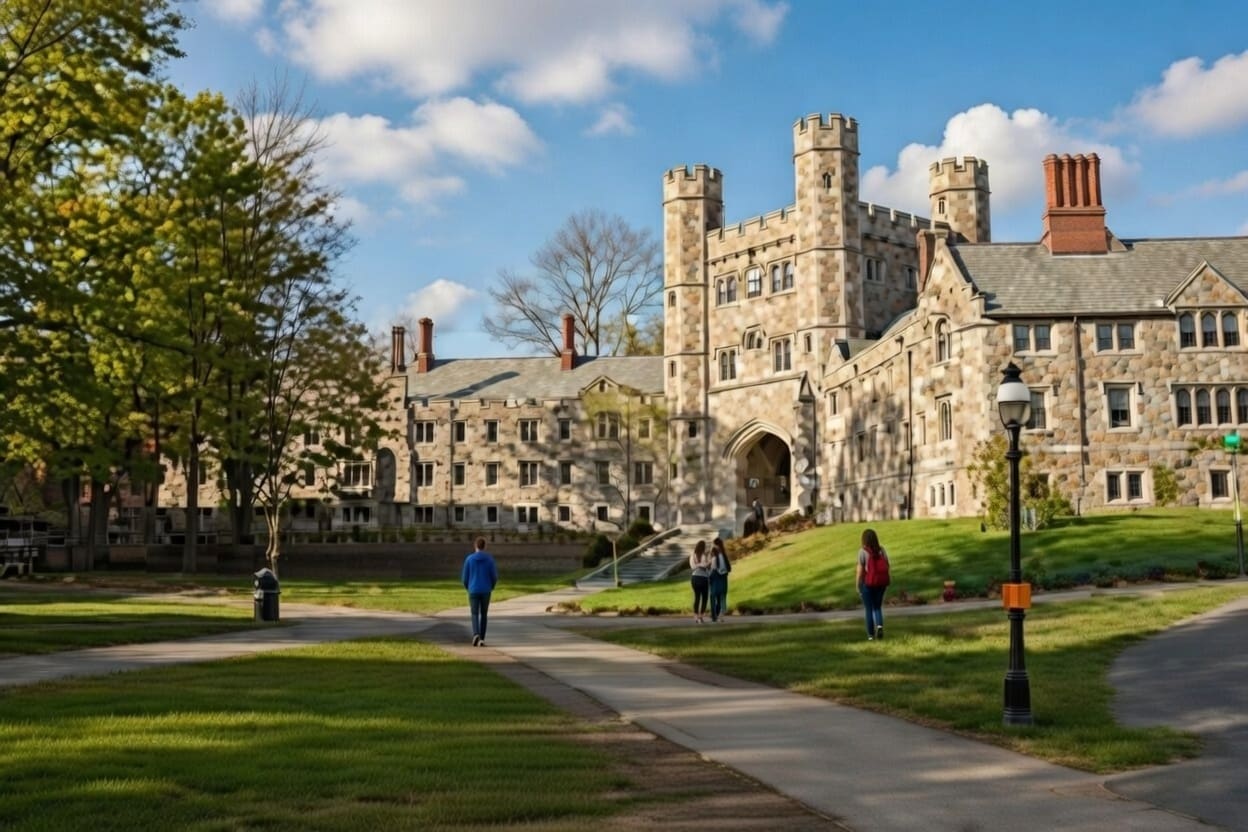
With its commitment to academic excellence and its storied history, Princeton is one of the most sought-after universities for higher education in the U.S. Every year, thousands of ambitious aspirants dream of joining this elite and intellectually vibrant community. Many are disappointed for not making it. Students and parents need to understand the acceptance trends at the university to make an informed choice. This blog will help current and prospective students tailor their college lists based on this blog.
For guidance on your university plans, explore Ivy Central’s college counseling services.
Changing trends
Princeton University has a reputation for having a highly rigorous selection process. Being a highly selective university, Princeton’s acceptance rates have become even lower in the last few years, and this is true for all the Ivy League colleges. The competitive nature of the application is revealed by the fact that for the class of 2027, the number of applications soared to 39,644 from 35,370 for the class of 2026 . Compared to that, for the class of 2028, the numbers had risen to 40,468; Princeton offered admission to 1,868 applicants in the class of 2028. This makes the acceptance rate 4.6%. Admission Statistics | Princeton Admission
Geographical Diversity
Among the first-time, first-year students who enrolled in the Class of 2028, Princeton reported representation from 48 states and 56 countries. See Princeton’s 2024 report. Enrolled-student figures should not be confused with the admitted pool.
Standardized testing
Princeton is test-optional for fall 2027 entry. For fall 2028 entry and beyond, Princeton generally requires the SAT or ACT, with an exemption for active military personnel. Check Princeton’s current testing policy.
A diverse student body
Princeton believes, “Diversity is not an end in itself but, rather, a precondition for academic excellence, institutional relevance, and national vitality.” They are working toward having a more diverse student body by expanding their undergraduate class profile. In 2024, 36 transfer students joined Princeton, which forms the largest cohort since Princeton reinstated its transfer program in 2018. This directly results in students from community colleges and military backgrounds entering Princeton’s academic community. Of the students offered admission, 52% are women and 48% are men. There has been a slight drop in the student body representing first-gen college students from 17% in 2027 to 16.3% in 2028.
Increased competitiveness
Princeton is looking for high school students who are among the best or possess the potential to do something phenomenal in the world. Students applying to Princeton are students with very high GPAs and a gamut of activities. The admissions officers are having a difficult time putting their finger on the best candidate. Hence they are looking for students with varied talents, exceptional personal qualities, and lived experiences that can differentiate candidates. You cannot be a run-of-the-mill applicant. Your work in high school must showcase your deep quest for learning, devotion to academic and non-academic pursuits, and integrity of character. When working on your profile, ensure you can bring distinctive academic and extracurricular talents that the college can benefit from.
Working with study abroad consultants, overseas education consultants, or, as more commonly known, college counselors, can help you plan and make those high school years count. We can help you with your college application process. Ivy Central offers exceptional focus to help you prepare for college admissions throughout the high school years. Start today!
Additional context
The following material is adapted from Jose’s article ‘Complete Guide About the Princeton University Acceptance Rate’, with sources linked below.
Early action and regular decision
First-year applicants can apply to Princeton through its nonbinding single-choice early action program or through regular decision. Single-choice early action restricts some other early applications; applicants should review Princeton’s current rules and exceptions before choosing a plan.
Application materials beyond scores
Princeton’s first-year application includes Princeton-specific questions and a graded written paper. Applicants also request a counselor recommendation and two teacher recommendations, allowing the university to consider more than grades and test scores.