
Admissions figures below describe the specified historical classes and may differ from later reports. Check Yale’s current admissions data before relying on them.
For guidance on your university plans, explore Ivy Central’s college counseling services.

Admissions and Acceptance Rates at Yale
Class of 2027 embarks on the shifting of the admissions landscape at Yale University since the pandemic. A remarkable number of changes have unfolded in the Classes of 2027, 2026, and 2025 at Yale University. Several preferences and trends have transformed the path to higher education.
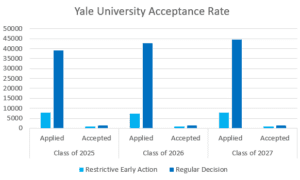
The overall acceptance rate of the Class of 2027 is 4.35%. The university received a total number of 52,250 applicants and 2,275 students were admitted. The low acceptance rate showcases the institution’s selective nature. However, a closer look at the data reveals an interesting shift. The trend shows that students are committing to their academic goals early on with Single Choice Early Action (Restrictive Early Action) acceptance rates rising to 10%. 7,744 applicants applied early for Yale and 776 students were admitted to the institution.
Class of 2026 also observed subtle changes within the summer admissions landscape with an overall acceptance rate of 4.47%. However, there was a noteworthy difference between regular decision and Single Choice Early Action (Restrictive Early Action) acceptance rates. Regular decision applicants faced increased competition, with an acceptance rate of 3.17%, while Single-Choice Early Action applicants had an acceptance rate of 12.09%. Among the 7,288 early applicants, 881 individuals were accepted.
The Class of 2025, also witnessed transformative shifts. The overall acceptance rate was 4.6%, however, there was a lower acceptance rate during the regular decision cycle. The acceptance rate during the regular decision cycle was 3.4%. On the other hand, Single Choice Early Action (Restrictive Early Action) applicants had an acceptance rate of 10.5%. 7,939 students applied through the Single Choice Early Action (Restrictive Early Action) and 837 students were accepted.
Read More: About Brown University
Yale’s Single-Choice Early Action is non-binding. A higher early-round rate does not establish an individual advantage; Yale says it uses the same evaluation criteria in both rounds.
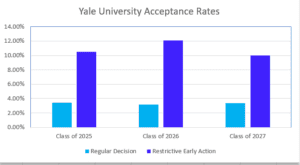
The trend of Classes of 2027, 2026, and 2025 reflect the ever-changing nature of acceptance rates. The data across the three years highlights the increasing competitiveness in the traditional admissions process. The halls of academia are embarking on a fascinating journey, where the pursuit of knowledge is intertwining with the winds of change with the help of Ivy Central.
Additional context
The following material is adapted from Jose’s article ‘Understanding Yale University’s Acceptance Rate’, with sources linked below.
Class of 2028: a historical snapshot
For the Class of 2028, Yale’s March 2024 announcement reported 2,146 admission offers from 57,465 applications, or approximately 3.7%. These are figures from that announcement, not the current admission rate.
Standardized testing
Yale now requires first-year applicants to submit SAT or ACT scores. AP or IB scores may also be submitted, but do not replace the SAT or ACT requirement. See Yale’s current testing guidance for details.
Financial aid for international applicants
Yale states that its undergraduate admissions are need-blind for all applicants, including international students, and that it meets 100% of each family’s demonstrated financial need. See Yale’s international admissions guidance.
Academic context in admissions
Yale describes the high school transcript as the most important application document. Its admissions officers consider coursework and achievement in the context of the opportunities available to each student, alongside the rest of the application. See what Yale looks for.
Interpreting early-action rates
Yale’s Single-Choice Early Action is non-binding. A higher early-round admission rate should not be treated as proof that applying early improves an individual’s chances: Yale says its evaluation criteria are the same and it gives no advantage for choosing Early Action. See Yale’s admissions timelines.