
This student was admitted to the University of Pennsylvania in Regular Decision by joining three strengths into one story: competitive singing, laboratory research and community service. Their music therapy initiative and an essay about overcoming stage fright showed Penn a student who uses talent to help other people.
This is Case Study 1 from our book, Inside Elite College Admissions. It is based on a real student profile that has been adapted and fully anonymized. It shows what worked for one student; it does not guarantee any outcome.
Who was the applicant?
| Detail | Profile |
|---|---|
| Citizenship | US citizen with a multicultural heritage |
| School | Private high school |
| Application | Regular Decision, University of Pennsylvania |
| Senior-year courses | AP Spanish, AP English Language, AP US Government, AP Psychology, AP Calculus BC; honors Anatomy/Physiology and History of Math |
| Academics | Weighted GPA of about 4.5, top 10 class rank |
| Recognition | A research scholarship; national scholarship semifinalist |
| Goal | A career in politics |
For context on how selective Penn is, see our page on Penn's acceptance rate.
What made the application stand out?
Music that served a purpose
The student was a competitive vocalist with state and regional podium finishes, national qualifier status and a solo performance at Carnegie Hall, singing opera, country and pop in several languages. The award list alone would not have been unusual among Penn applicants. What made it distinctive was what they did with it.
They founded a music therapy initiative with a medical center, bringing performances to Alzheimer's facilities and retirement homes. They were also lead vocalist in a nonprofit band that raised money for community causes.
Real research
In a pharmacology and neuroscience internship, the student studied how a medication affects fetal brain development, using laboratory techniques such as protein analysis, and presented the results. They also wrote a book on political debates that drew media attention, which tied directly to their interest in politics.
Leadership with results
They were president of the National Honor Society and of their Future Business Leaders of America chapter, where they helped run a student coffee shop. They served as a class officer, taught younger students as a Kumon instructor, served as lead representative on a youth council for mental health, coordinating a statewide summit, and delivered meals with a food insecurity organization.
A multicultural, well-rounded profile
The student spoke several languages, performed traditional songs from their heritage and practiced yoga. They also managed a junior varsity tennis team and took part in mock trial, model congress and a local theater production.
What did the personal essay say?
The essay traced the student's relationship with singing. As a young child they sang a traditional song with complete confidence. Later, at a competition, cultural differences left them with stage fright. They spent years practicing privately, until a confrontation with their voice teacher changed their purpose: to connect with an audience emotionally, not to win approval.
The essay ended with the student singing for an 80-year-old patient with dementia, and the moment music reached across language, culture and age. It showed resilience, growth and a reason for everything else in the application.
Why did it work for Penn?
The application was coherent. Music, science, politics and service all pointed to the same person: someone who turns a personal talent into something useful for others. In our reading, that mix of intellectual curiosity, initiative and social responsibility, together with a multicultural perspective and interdisciplinary interests, matched what Penn values in its students.
What can other applicants learn from it?
- Use your talent for impact. A skill becomes memorable when it helps someone else.
- Show growth, not just success. Stage fright made a stronger essay than a trophy would have.
- Let interests cross subjects. Music, neuroscience and politics looked unusual together, and that was the point.
- Start something. Founding an initiative says more than holding a title.
- Bring your background with you. Languages and cultural traditions gave the profile depth.
Five project ideas inspired by this profile
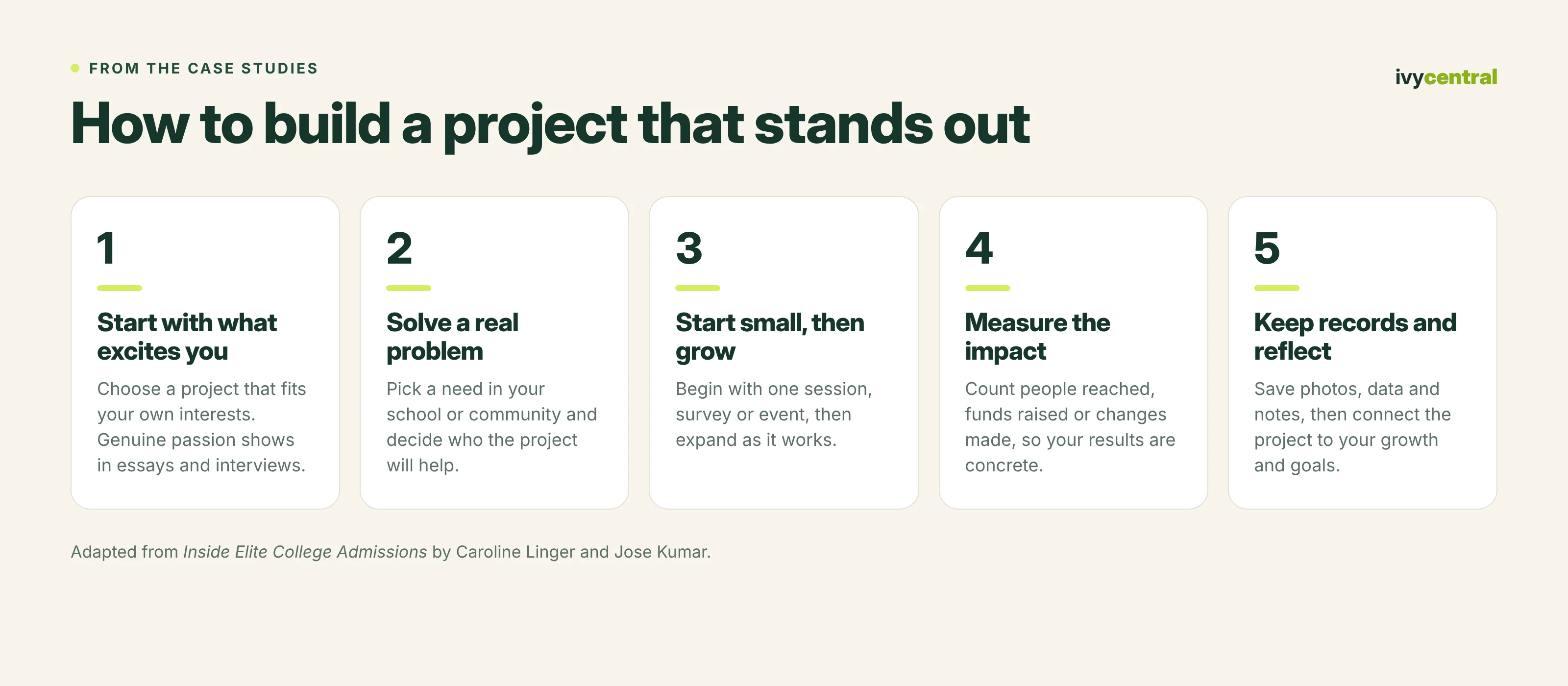
These are adapted from the book. Pick one that fits your own interests rather than copying the student's.
| Project | What you do | How to start | How to describe it |
|---|---|---|---|
| Music for healing | Performances or workshops at senior centers, hospitals or schools with few arts programs | Contact one organization; plan 3 to 5 sessions over a month for at least 20 people | Number of people reached and what changed for them |
| Research on a local issue | Survey students on, for example, whether music programs affect stress | Build a short Google Forms survey; collect 50 to 100 responses; present findings to your school | Your question, method and one clear finding |
| Global Arts Day | A school event celebrating cultures through music, dance, art or food | Partner with cultural clubs; plan 5 to 10 performances or booths | Scale: performers and attendance |
| Student well-being campaign | Use a student government role to push for, say, a mental health awareness week | Identify a need, write a proposal, run it for a semester | Participation or measurable change |
| Language bridge | Tutor or translate for families who do not speak English | Offer 2 to 3 hours a week to a local ESL or refugee program for a semester | Students helped and their progress |
For more ways to build a project from scratch, read our guide to passion projects for high school students.
Is your child's profile heading in a similar direction?
Many students have the raw material for an application like this one: a talent, an interest in a cause, a story they have never told. The work is connecting them. That is what we do in a free strategy call.
Frequently asked questions
What GPA did this Penn admit have?
A weighted GPA of about 4.5, with a top 10 class rank and a demanding AP and honors schedule.
Did the student apply Early Decision to Penn?
No. They applied in the Regular Decision round.
Do you need research to get into Penn?
No single activity is required. In this case, research added academic depth to a profile built around music and service.
What was the Penn personal essay about?
Overcoming stage fright and discovering that singing was about connecting with people, ending with a performance for a patient with dementia.
Can I copy this profile?
No. The lessons travel; the specific activities should come from your own interests, or the application will not sound like you.
Read the other case studies
See what all ten admitted students had in common, read the Stanford case study, or explore our Ivy League admissions strategy guide.
Sources
- Caroline Linger and Jose Kumar, Inside Elite College Admissions: 10 Real-World Case Studies (2025), Case Study 1.