
This international IB student was admitted to Stanford in Regular Decision by pairing top academics with research that had a human purpose. Their work on removing bias from AI language models grew out of a childhood love of folk tales and a goal of making children's books more inclusive, which gave Stanford a clear picture of who they were.
This is Case Study 2 from our book, Inside Elite College Admissions. It is based on a real student profile that has been adapted and fully anonymized. It shows what worked for one student; it does not guarantee any outcome.
Who was the applicant?
| Detail | Profile |
|---|---|
| Citizenship | Non-US citizen with a multicultural background |
| School | International school, IB Diploma Programme |
| Application | Regular Decision, Stanford University |
| IB subjects | Higher Level Mathematics: Analysis and Approaches, Physics and Biology; Standard Level English, Spanish and Economics |
| Academics | 42 out of 42 in IB subject grades (core points are scored separately), 10 A* grades at IGCSE, SAT 1550 |
| Extra study | Advanced online math courses from MIT; selective summer programs |
| Goal | Using mathematics and AI for social impact |
For context on how selective Stanford is, see our pages on Stanford's acceptance rate and what to know about Stanford.
What made the application stand out?
Research with a reason
The centerpiece was independent research on de-biasing AI language models. The student presented it at an undergraduate research and technology conference, and the paper was accepted for publication. Because it tackled bias in technology, it connected directly to the student's goal of inclusive innovation.
Industry and lab experience
As a junior research engineer at a technology company, the student built AI tools to improve image generation. They also interned at a university lab improving clustering algorithms and explored applications of quantum computing.
Leadership in teaching math
The student founded their school's first competitive math club, teaching students from Grades 6 to 12 and creating their own materials. They also sat on the organizing committee of a student-run math outreach group that ran competitions for hundreds of participants, and wrote curricula for math programs.
A full life outside the lab
They played classical and contemporary music, competed in sports, served as treasurer of a girls' education club that raised significant funds, co-founded a startup that won a pitch contest, and took part in robotics competitions and hackathons. Awards included a gold medal in an international math competition and a Presidential Service Gold Medal for volunteering.
What did the personal essay say?
The essay began with the student's childhood love of folk tales and the realization that the Western children's books around them rarely reflected different cultures. That gap led to an idea: personalized stories for children that address literacy and representation.
From there, the essay connected naturally to the AI research. Removing bias from language models was not an abstract technical exercise; it was a step toward children's stories in which more children could see themselves.
Why did it work for Stanford?
Every part of the profile pointed in one direction. Advanced math and AI showed ability. The research showed initiative. The math club showed leadership. The essay explained why it all mattered to this student. In our reading, that blend of technical depth, interdisciplinary thinking and social purpose, together with a cross-cultural perspective, is a strong fit for Stanford's emphasis on innovation.
What can other applicants learn from it?
- Give technical work a purpose. The research mattered because of who it was meant to help.
- Go beyond the classroom. Publications, conferences and internships showed initiative, not just good grades.
- Lead by teaching. Starting a math club made the student's passion visible in their community.
- Connect a personal story to a bigger problem. Folk tales led to AI fairness, which led to literacy.
- Keep balance. Music, sport and service showed a whole person, not only a researcher.
Five project ideas inspired by this profile
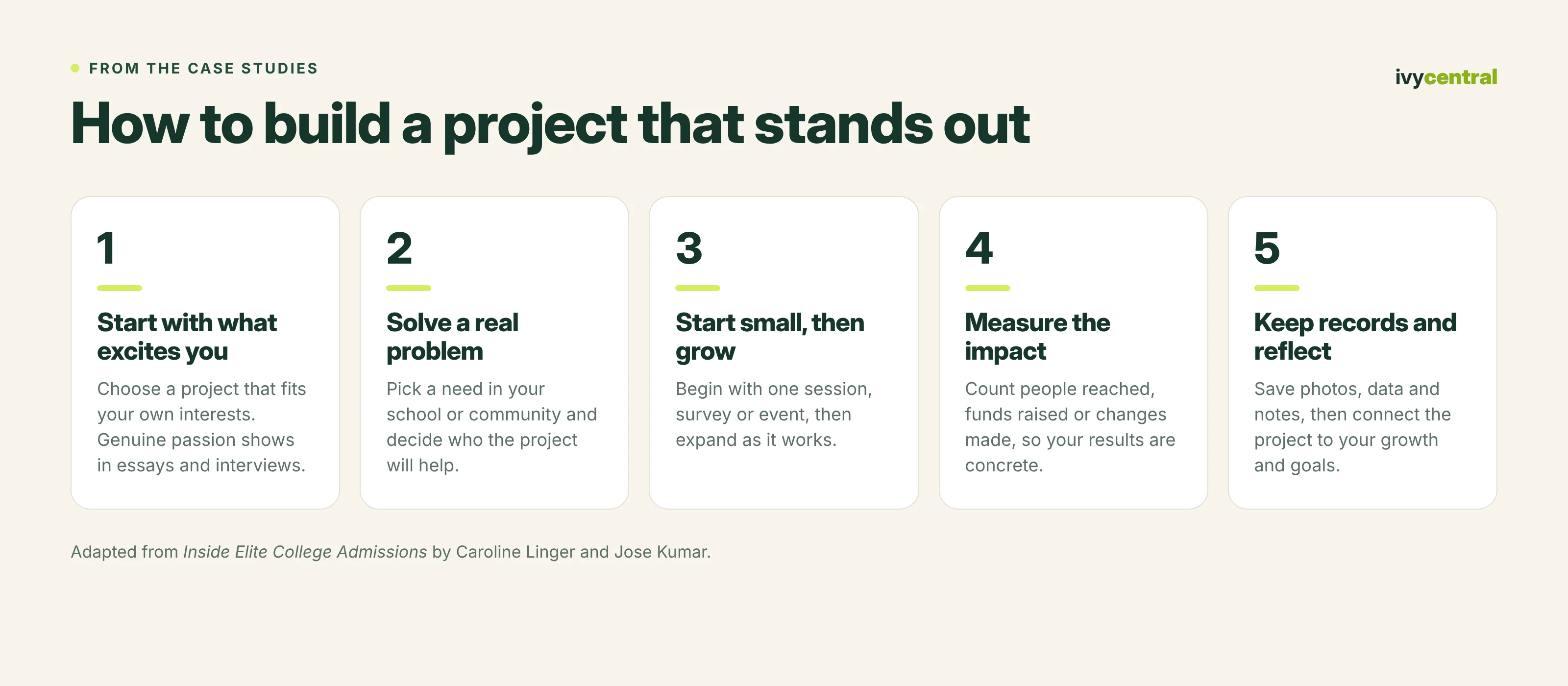
These are adapted from the book. Start with whichever fits your interests; you do not need to code to make an impact.
| Project | What you do | How to start | How to describe it |
|---|---|---|---|
| Community data project | Analyze a local problem such as traffic near schools, recycling or park use | Collect data for a few weeks; analyze in Excel or Python; present to a school board or council | The problem, your finding and the change you proposed |
| Tech for good app | Build a simple app or website for a community need, such as sharing surplus food | Sketch it, build a prototype in a month with free tools, test with classmates | Who uses it and what it changed |
| Math mentorship | Run peer tutoring for younger students using games and real-world problems | Recruit 2 or 3 peers; tutor 10 to 15 students for a semester | Students tutored and their progress |
| Cultural storytelling archive | Collect stories from different cultures in your community and publish them | Interview 5 to 10 elders; publish on a simple website; host a reading | Stories collected and cultures represented |
| Environmental STEM challenge | Organize a competition to design low-cost solutions to an environmental problem | Set the challenge, recruit teams, find teacher mentors, host a showcase | Teams led and any solution adopted |
For structured research opportunities, see our list of summer research programs for high school students. International applicants can find more in our guide for international students.
Could your child's interests become a story like this?
Strong students often have the pieces (a subject they love, a cause they care about, a memory that explains why) without seeing how they connect. We help them find that thread in a free strategy call.
Frequently asked questions
Can international students get into Stanford?
Yes. This applicant was a non-US citizen at an international school following the IB Diploma Programme.
What SAT score did this Stanford admit have?
1550 out of 1600, alongside top IB and IGCSE results.
Do you need published research to get into Stanford?
No. Research strengthened this application because it was tied to a clear purpose, but many admitted students have no publications.
What was the Stanford personal essay about?
A childhood love of folk tales, the lack of cultural diversity in children's books, and how that led to research on bias in AI.
Did the student apply early to Stanford?
No. They applied in the Regular Decision round.
Read the other case studies
See what all ten admitted students had in common, read the Penn case study, or get our tips for the Stanford supplemental essays.
Sources
- Caroline Linger and Jose Kumar, Inside Elite College Admissions: 10 Real-World Case Studies (2025), Case Study 2.