
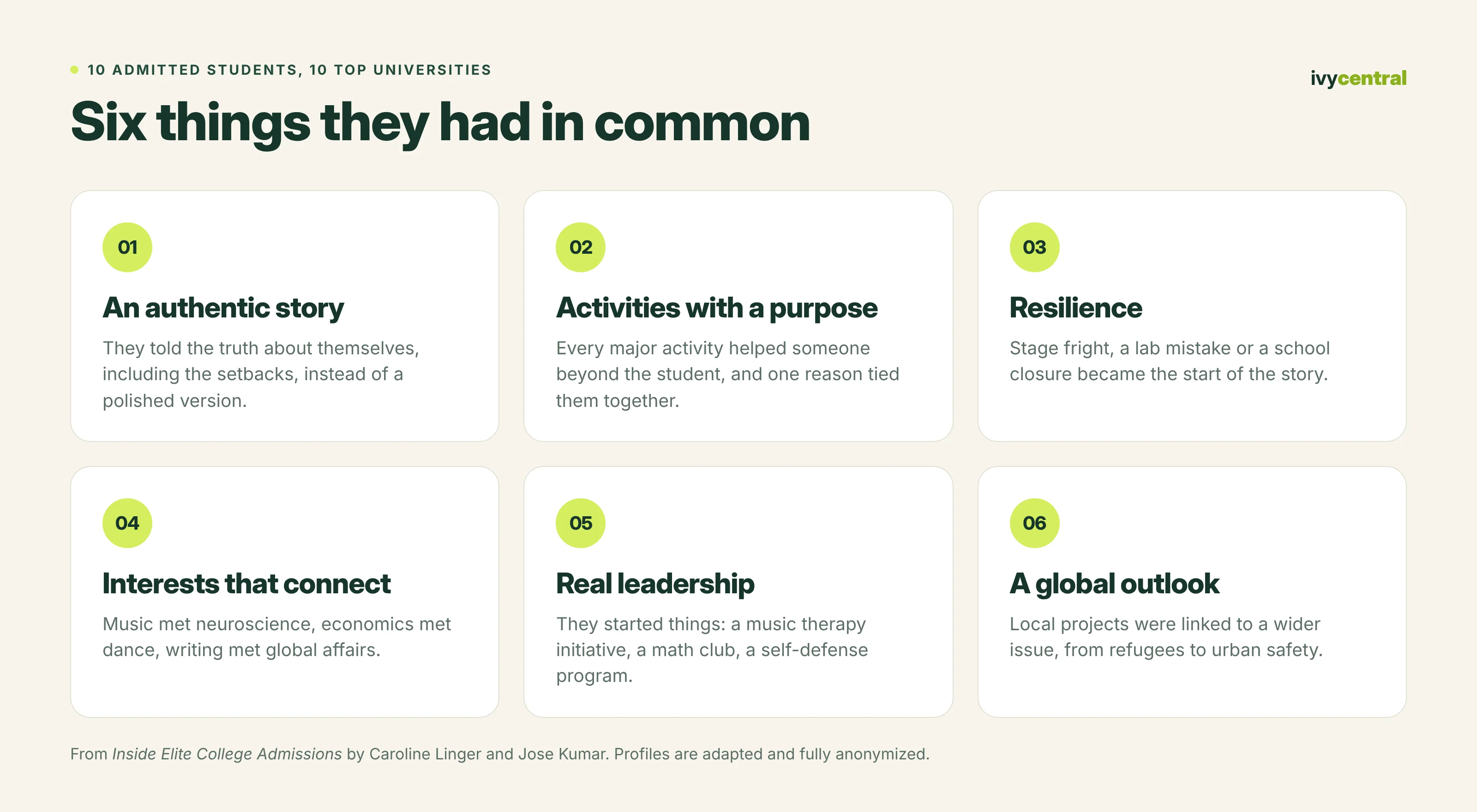
Ten students admitted to Penn, Stanford, UChicago, Yale, Duke, Johns Hopkins, Cornell, Harvard, Brown and Princeton shared six patterns: an authentic personal story, activities with a clear purpose, resilience, interests that crossed subjects, real leadership and a global outlook. Strong grades got them considered. These six qualities set them apart.
The profiles below come from our book, Inside Elite College Admissions. Each is drawn from a real student, then adapted and fully anonymized. They show what worked for these students; they are not a formula, and no profile guarantees an admission.
Who were the ten students?
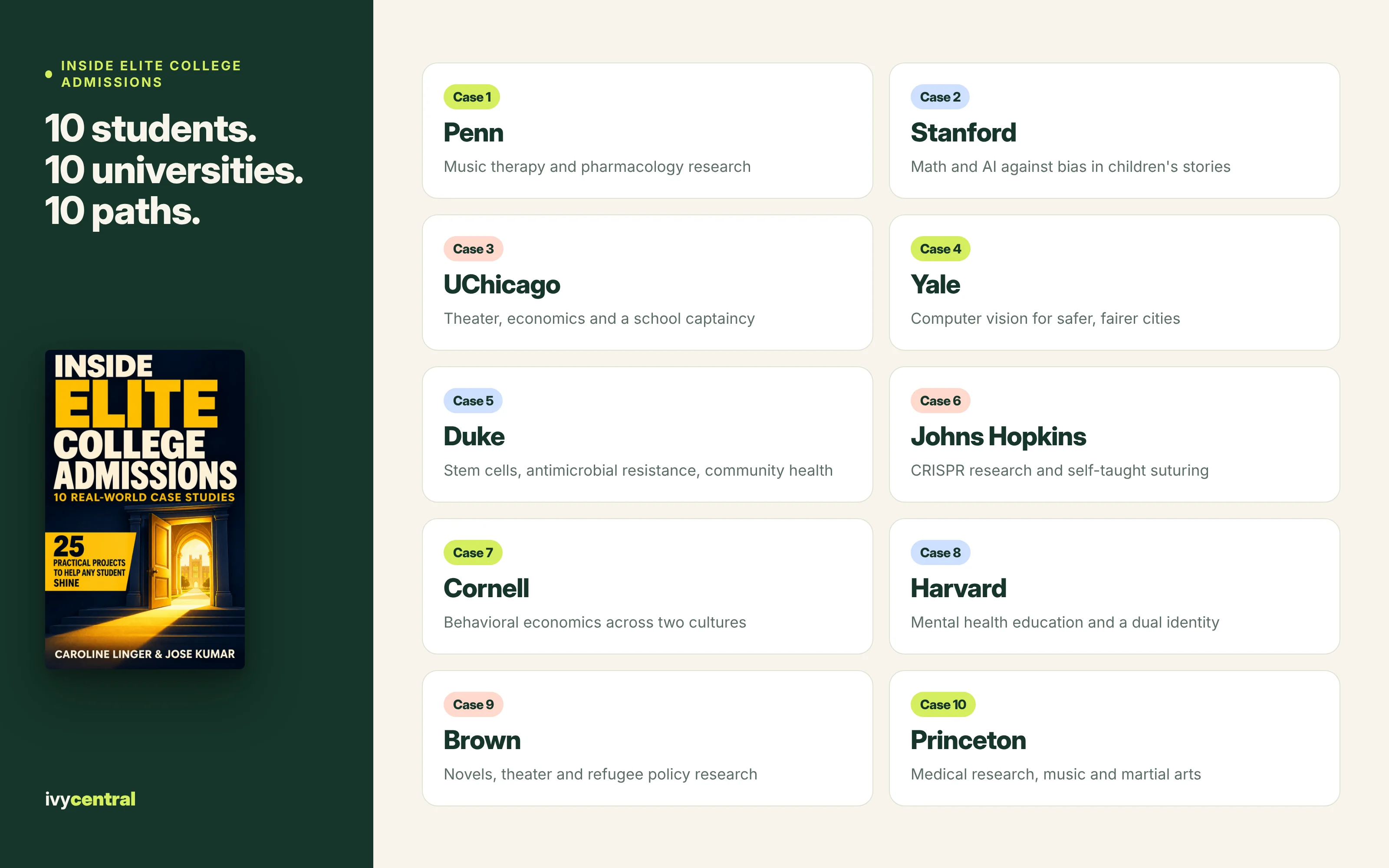
| # | University | What defined the application |
|---|---|---|
| 1 | University of Pennsylvania | Competitive singing turned into a music therapy initiative, plus pharmacology research |
| 2 | Stanford University | Research on bias in AI language models, driven by a love of folk tales |
| 3 | University of Chicago | Theater and a school captaincy used to tackle economic inequality |
| 4 | Yale University | Computer vision projects on distracted driving and support for street vendors |
| 5 | Duke University | Stem cell and antimicrobial resistance research alongside community health work |
| 6 | Johns Hopkins University | Medical research and personal resilience behind a goal of becoming a doctor |
| 7 | Cornell University | Cultural heritage and dance connected to behavioral economics |
| 8 | Harvard University | A dual cultural identity, speech competition and a mindfulness curriculum |
| 9 | Brown University | Poetry, theater and research on refugee integration |
| 10 | Princeton University | Scientific research, classical music and a self-defense initiative for girls |
Most of these students had weighted GPAs above 4.0 and SAT scores above 1500 (or ACT above 33). That is typical of applicants to these universities, which is exactly why grades alone rarely decide the outcome.
Pattern 1: Was their story authentic or polished?
Authentic. None of the ten presented a flawless version of themselves. The Penn applicant wrote about stage fright at a competition, years of practicing alone, and the moment a voice teacher changed what singing meant to them. The Brown applicant wrote about building fictional worlds through poetry and theater.
What to do: stop asking "what do admissions officers want to hear?" and start asking "what is true about me that nobody else could write?"
Pattern 2: Did their activities serve a purpose?
Yes, and that purpose was larger than the student. The Stanford applicant's AI research was aimed at children's books that represent more cultures. The Harvard applicant paired speech and yoga with a mindfulness curriculum they developed. Activities were connected by a reason, which is what counselors mean by an extracurricular spike.
What to do: for each activity, write one sentence on who it helps beyond you. If you cannot, it may be filler.
Pattern 3: How did they handle setbacks?
They used them. The UChicago applicant turned personal challenges into leadership roles. The Johns Hopkins applicant's resilience shaped both their research and their goal of studying medicine. In each case, the setback was not hidden; it showed maturity.
What to do: a hard moment you grew from often makes a stronger essay than an achievement. Look for change, not just difficulty.
Pattern 4: Did they stick to one subject?
No. The strongest profiles crossed subjects in a way that made sense: music and neuroscience (Penn), economics and dance (Cornell), writing and global affairs (Brown), science, music and martial arts (Princeton). The combination was memorable because each part explained the others.
What to do: do not drop an interest because it seems unrelated to your intended major. Ask how it connects.
Pattern 5: What did their leadership look like?
They started things. The Penn applicant founded a music therapy initiative with a medical center. The Stanford applicant founded their school's first competitive math club. The Princeton applicant built a self-defense program for girls. Titles mattered less than what changed because the student was there.
What to do: one initiative you built and grew is worth more than five club memberships. Our guide to extracurricular activities for Ivy League applicants covers how to choose.
Pattern 6: Did they think beyond their own community?
Many did. The Brown applicant researched refugee integration. The Yale applicant applied technology to urban problems. The group included both US and non-US citizens, and several brought a cross-cultural view to everything they did.
What to do: connect a local project to a wider issue, and say so in your application.
What do these patterns mean for your application?
| If your profile is... | Consider... |
|---|---|
| Strong grades, many unconnected activities | Choosing the one or two that matter most and building them into a project with a purpose |
| Deep in one subject only | Adding the human side: who benefits from your work, and why you care |
| Full of achievements but no struggle | Finding the moment you changed your mind or failed, for the essay |
| Local and school-based | Linking your work to a broader issue or community |
These are the same questions we work through with students one to one. If you would like a second opinion on your child's profile, a free strategy call is the place to start.
Where can you read each case study?
- Penn: music, research and service
- Stanford: math and AI for social good
- UChicago: theater, economics and leadership
- Yale: technology and resilience for a better city
- Duke: biomedical research and community health
- Johns Hopkins: medicine, research and resilience
- Cornell: behavioral economics and two cultures
- Harvard: mental health advocacy and a dual identity
- Brown: writing, theater and global advocacy
- Princeton: science, music and martial arts
The full set of ten, with practical project ideas for every profile, is in Inside Elite College Admissions. For the bigger picture, see our Ivy League admissions strategy guide and our advice on writing college essays.
Frequently asked questions
Do you need perfect grades to get into the Ivy League?
Most students in these case studies had weighted GPAs above 4.0 and SAT scores above 1500. Those numbers made them competitive, but the essays, activities and recommendations are what distinguished them from other strong applicants.
What is the most important part of an Ivy League application?
There is no single part. In these ten cases, the deciding factor was how well the parts fit together into one believable story with a clear purpose.
Should students copy these profiles?
No. The case studies are meant to show the thinking, not to be imitated. A copied profile reads as inauthentic, which works against the applicant.
Are these real students?
Each case study is based on a real student profile that was adapted and fully anonymized to protect their identity.
Can international students follow the same approach?
Yes. The group included both US and non-US citizens. The Stanford applicant, for example, was an IB student at an international school.
Get help applying this to your child
Book a free strategy call with Caroline Linger or Jose Kumar.
Sources
- Caroline Linger and Jose Kumar, Inside Elite College Admissions: 10 Real-World Case Studies (2025).