
This IB student was admitted to the University of Chicago in Regular Decision by linking three things: research in economics, leadership as school captain and years of theater. Their essay showed how the stage turned a nervous, curious child into a confident leader, and their research applied economic ideas to real problems such as wage compliance.
This is Case Study 3 from our book, Inside Elite College Admissions. It is based on a real student profile that has been adapted and fully anonymized. It shows what worked for one student; it does not guarantee any outcome.
Who was the applicant?
| Detail | Profile |
|---|---|
| Citizenship | US citizen |
| School | Independent international school, IB Diploma Programme |
| Application | Regular Decision, University of Chicago |
| IB subjects | Higher Level Mathematics: Analysis and Approaches, History and Economics; Standard Level English Language and Literature, French and Biology |
| Extended Essay | Economics |
| Extra study | College-credit summer program at a US college; a Math Circle exploring college-level mathematics |
| Goal | Becoming a business owner and addressing economic inequality |
For context, see our pages on UChicago's acceptance rate and what to know about the University of Chicago.
What made the application stand out?
Economics research applied to real problems
In a summer research program the student studied game theory and duopolies, earning high marks and college credit. As an intern at a scientific research center they analyzed data on the spread of COVID-19 that fed into a model used by a health organization. On their own, they collected primary data on wage compliance to show gaps in how labor laws were enforced. Each project took economic theory into the real world.
Leadership as school captain
As school captain and a member of the school's administrative council, the student led a recycling program, environmental restoration work and research into soil health. With a local Interact Club they helped run vaccination drives in rural communities that reached thousands of children. They also organized a conference and pitched business ideas in an entrepreneurship program.
Theater that changed them
Theater ran through the whole application. The student played lead roles in city-wide and school productions, including The Mousetrap, and worked behind the scenes as head of props and scriptwriter. A student-written play about social problems won awards and sold thousands of tickets. The confidence they gained on stage showed up in Model UN, debate and community advocacy.
A balanced profile
The student was a national-level competitive golfer and team captain, wrote content for a family business, and raised funds for rural families with an NGO during the pandemic.
What did the essays say?
The personal essay began with a curious child who loved learning from intellectual media. A first musical drew them into drama, and theater slowly replaced nervousness with bold, deliberate action on stage. That change carried into everyday life: discussions, relationships and, eventually, their leadership as school captain, where they tried to build a compassionate and committed student body. The essay was about growth, and it explained why someone shy became someone others followed.
Why did it work for UChicago?
The pieces fitted together. Economics was the intellectual thread, inspired by UChicago scholars and shown through real research. Theater explained the personal change. Leadership showed what they did with it. In our reading, that mix of intellectual curiosity, interdisciplinary interests and social purpose is what made the application a strong fit for UChicago.
What can other applicants learn from it?
- Turn a passion into a contribution. Theater built confidence; research and leadership put it to work.
- Lead toward a problem. The school captaincy mattered because of the projects it produced, from recycling to vaccinations.
- Show intellectual curiosity in action. Game theory, data modeling and wage research proved the interest in economics was real.
- Tell a story of change. The essay showed who the student had become, not just what they had done.
- Keep a full life. Golf, writing and service added discipline and range.
Five project ideas inspired by this profile
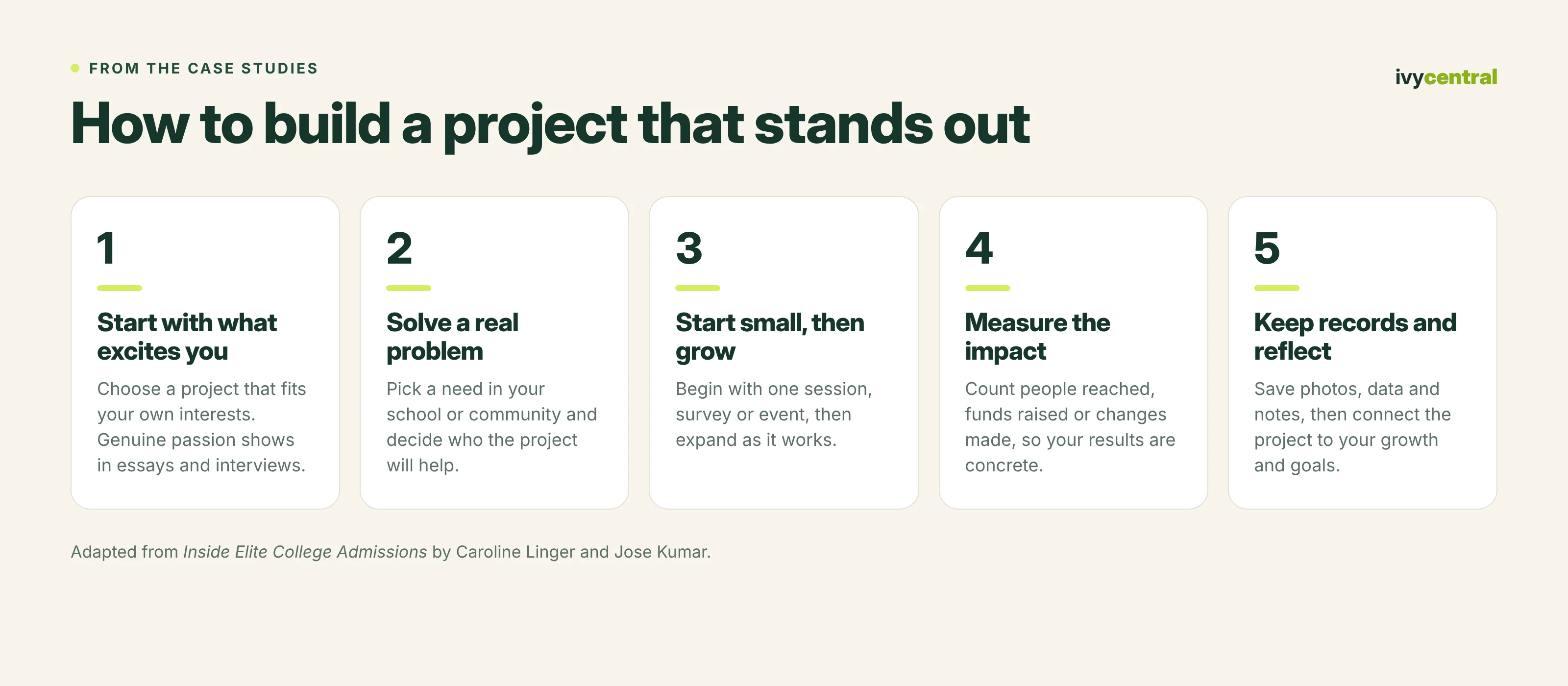
These are adapted from the book. Choose the one that fits your own interests rather than copying the student's.
| Project | What you do | How to start | How to describe it |
|---|---|---|---|
| Community research project | Investigate a local issue such as transit access for low-income neighborhoods or food insecurity | Run 20 to 30 surveys over a few weeks; write a short report; share it with a club or local government | The question, your finding and who heard it |
| Interdisciplinary leadership initiative | Tackle an issue like student stress with workshops, a podcast of peer stories and posters by art students | Recruit 3 to 5 peers with different skills; set a goal such as reaching 100 students in a semester | Students reached and feedback gathered |
| Creative arts for social change | Write and stage a short play, film a video series or build a photo exhibit on an issue you care about | Spend 1 to 2 months creating it; present to at least 20 people | Audience, reactions and any awards |
| Entrepreneurial venture with a purpose | Start a small business that solves a problem, such as a peer tutoring network or eco-friendly products with proceeds donated | Test the idea with 5 to 10 customers; track earnings or impact for a month | What you built, who it helped and what you learned |
| Advanced academic exploration | Study a subject beyond your curriculum, then design a mini experiment or write about it | Spend 2 to 3 hours a week for a month; write a short paper or blog post; present it to peers | What you studied and what you found |
Students drawn to economics may also like our list of the best universities for economics in the US, and anyone building speaking skills should read why Model United Nations helps.
Does your child have a story of change like this?
Many students have grown in ways they have never written about. Finding that story, and the activities that prove it, is the core of what we do in a free strategy call.
Frequently asked questions
Did this UChicago admit apply Early Decision?
No. They applied in the Regular Decision round.
What did the student want to study at UChicago?
Economics, with the goal of becoming a business owner and addressing economic inequality.
Do you need research to get into UChicago?
No single activity is required. In this case, economics research showed that the student's interest went beyond the classroom.
What was the personal essay about?
How theater turned a nervous, curious child into a confident leader, and how that shaped their role as school captain.
Can an IB student at an international school get into UChicago?
Yes. This applicant was a US citizen studying the IB Diploma at an independent international school.
Read the other case studies
See what all ten admitted students had in common, read the Yale case study, or see the UChicago supplemental essay prompts.
Sources
- Caroline Linger and Jose Kumar, Inside Elite College Admissions: 10 Real-World Case Studies (2025), Case Study 3.