
This international IB student was admitted to Yale in Regular Decision after turning a pandemic setback into action. They built an AI model to prevent road accidents, helped more than 200 street vendors restart their businesses, and led their school through the move online. Their essay explained how disruption changed their goals.
This is Case Study 4 from our book, Inside Elite College Admissions. It is based on a real student profile that has been adapted and fully anonymized. It shows what worked for one student; it does not guarantee any outcome.
Who was the applicant?
| Detail | Profile |
|---|---|
| Citizenship | Non-US citizen |
| School | Independent international school, IB Diploma Programme |
| Application | Regular Decision, Yale University |
| IB subjects | Higher Level Mathematics: Analysis and Approaches, Chemistry and History; Standard Level English Language and Literature, Economics and Spanish |
| Testing | SAT 1590 (800 Math); AP Computer Science A score of 5 |
| Extra study | Summer program at a US university; an MIT Linear Algebra course; IGCSE academic excellence award |
| Goal | Entrepreneurship and an MBA, using technology to solve urban problems |
For context, see our pages on Yale's acceptance rate and what to know about Yale.
What made the application stand out?
Technology aimed at real urban problems
The student built an AI accident prevention model using computer vision and deep learning to reduce road deaths. It led to a published research paper and a planned collaboration with a major ridesharing company. They also wrote an algorithm to help optimize traffic flow, and worked on road condition detection, fake news detection and medical imaging.
A street vendor initiative
When COVID-19 hit, the student founded an initiative for street vendors. It designed hygienic carts with contactless payment and helped more than 200 vendors secure trade licenses and loans.
Industry research
At a technology company working to cut particulate pollution, the student co-authored a peer-reviewed paper on early results. At a startup they developed algorithms to analyze user behavior.
Leadership through a crisis
As class president during the pandemic, the student led the school's move to online learning, with a focus on mental health and academic support. They ran FAQ sessions, worked with psychologists and set up a mentorship program with NGOs and experts. They also campaigned successfully for electric transport and organized their country's first online interschool festival, raising money for charity.
Music and sport
They co-founded a band and wrote original music, and held a state record in the javelin.
What did the essays say?
The essay began with a setback: the school closed suddenly because of COVID-19 just as the student was preparing for board exams. At first, the move online and the uncertainty were overwhelming. Then they noticed street vendors struggling to survive and traffic getting worse, and turned frustration into action, building technology to help. The essay showed a shift from personal academic success to a commitment to improving life in their city.
Why did it work for Yale?
The application had a clear arc. A disruption became a turning point, and every major activity afterward (the accident model, the vendor initiative, the online school transition) was a response to a real problem. In our reading, that combination of technical skill, leadership and social purpose matched Yale's emphasis on leadership and impact.
What can other applicants learn from it?
- Use technical skills for people. The AI and data work mattered because of who it was meant to protect.
- Let a setback start something. The essay turned the pandemic into the beginning of the story, not an excuse.
- Lead when it is hard. Running a school's move online is leadership under pressure.
- Combine fields. Computer science, urban issues, music and athletics made a memorable mix.
- Connect your city to your goals. Local problems tied the student's ambitions to a place and a purpose.
Five project ideas inspired by this profile
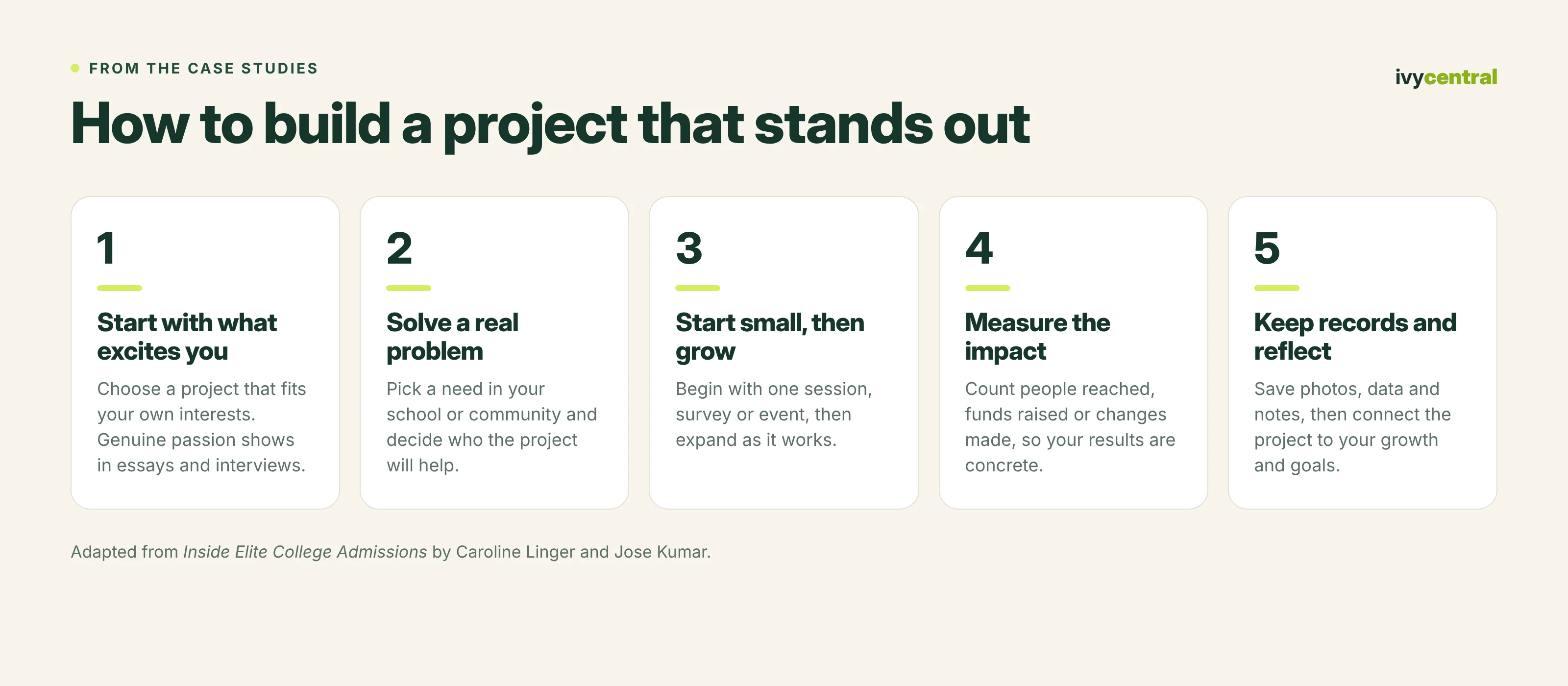
These are adapted from the book. Choose the one that fits your own interests rather than copying the student's.
| Project | What you do | How to start | How to describe it |
|---|---|---|---|
| Map local needs | Use free tools like Google My Maps to map potholes, unsafe crossings or areas without public Wi-Fi | Log issues for a week; map them; present to a neighborhood group or official | Issues reported and any that were fixed |
| Support local workers | Run a Shop Local drive or create a resource guide for gig workers or small vendors | Pick one group; build a one-page site or flyer; run it for 4 to 6 weeks | Vendors or workers helped and the result |
| Peer support network | Pair students as study buddies or host Q&A sessions on managing workload | Survey peers' needs; recruit 3 to 5 helpers; pilot for a semester | Students supported each week |
| Green advocacy campaign | Push for bike racks, a no-car day or a recycling guide | Research cost and feasibility; campaign for 2 to 3 months | Signatures collected and changes made |
| Digital story of a setback | Turn a personal challenge into a short video, podcast or illustrated blog | Outline how it changed you; create it over a month with free tools | Who saw it and what it shows about you |
International applicants can find more in our guide for international students, and our page on what counts as a good SAT score puts testing in context.
Has your child faced a setback that could become their story?
The strongest essays often start with something that went wrong. We help students find that moment and connect it to what they did next in a free strategy call.
Frequently asked questions
Can international students get into Yale?
Yes. This applicant was a non-US citizen studying the IB Diploma at an international school.
What SAT score did this Yale admit have?
1590 out of 1600, with 800 in Math, plus a 5 in AP Computer Science A.
Did the student apply early to Yale?
No. They applied in the Regular Decision round.
What was the Yale personal essay about?
How the sudden closure of their school during COVID-19 pushed them from focusing on their own results to building technology for their city.
Do you need published research to get into Yale?
No. Research strengthened this application because it solved a real problem, but it is not a requirement.
Read the other case studies
See what all ten admitted students had in common, read the UChicago case study, or see the Duke case study.
Sources
- Caroline Linger and Jose Kumar, Inside Elite College Admissions: 10 Real-World Case Studies (2025), Case Study 4.