
This IB student was admitted to Brown in Regular Decision as a writer with a global outlook. They had published two novels, led the drama club, produced a policy paper on integrating refugees in the EU and organized an MUN conference for over 600 delegates. Their essays showed why Brown's Open Curriculum suited them.
This is Case Study 9 from our book, Inside Elite College Admissions. It is based on a real student profile that has been adapted and fully anonymized. It shows what worked for one student; it does not guarantee any outcome.
Who was the applicant?
| Detail | Profile |
|---|---|
| Citizenship | US citizen with a multicultural heritage, raised abroad |
| School | Independent international school, IB Diploma Programme |
| Application | Regular Decision, Brown University |
| IB subjects | Higher Level English Literature, History and Biology; Standard Level Math, French B and Economics |
| Testing | ACT 36; 5 in AP English Literature and AP Psychology |
| Extra study | Competitive summer program at a US university |
| Goal | A career in consulting, studying International Relations |
For context, see our pages on Brown's acceptance rate and what to know about Brown.
What made the application stand out?
Writing and theater
The student wrote and published two fiction books. In theater they acted, directed and produced, won a national drama award and, as head of the drama club, staged plays about abuse and the effect of social media on mental health.
Research on global issues
At a US university summer program, they wrote a policy paper on refugee integration in the EU and presented it at a symposium. They interned at a nonpartisan think tank working on international affairs and independently researched the rise of fundamentalism.
Leadership and service
The student led the team that organized an MUN conference with over 600 delegates, and won Best Delegate awards at major conferences. They volunteered as a Listener offering anonymous support to teenagers on mental health platforms, helped a politician draft manifestos and organized a cultural festival that raised money for charity.
A global background
Born in the US, raised abroad and with frequent time in Africa, the student spoke English and French, and their family's refugee experience shaped their interest in global conflict.
What did the essays say?
The personal essay began with a child who read so much that their mother ran out of books and challenged them to write their own. That challenge turned a reader into a writer of poetry, plays and fiction about emotions and social issues. In supplemental essays, the student described a family that creates magic through games, traditions and support; explained that their interest in International Relations came from their family's refugee history and wide reading; and showed how Brown's Open Curriculum would let them combine English, Biology, History, Sociology and Political Science.
Why did it work for Brown?
Brown's Open Curriculum rewards students who know how to design their own education, and this student had already shown it: writing, theater, policy research and diplomacy all came from one curious mind. In our reading, the specific Open Curriculum plan and a personal reason for studying International Relations made the fit with Brown unusually clear.
What can other applicants learn from it?
- Create, don't just consume. Turning a love of reading into published books showed initiative.
- Use art to say something. The drama club's plays tackled real social issues.
- Connect family history to your studies. A refugee background gave the interest in International Relations a personal reason.
- Lead at scale. A 600-delegate MUN conference showed real organizational skill.
- Show why the curriculum fits you. The Open Curriculum plan proved the student understood Brown.
Five project ideas inspired by this profile
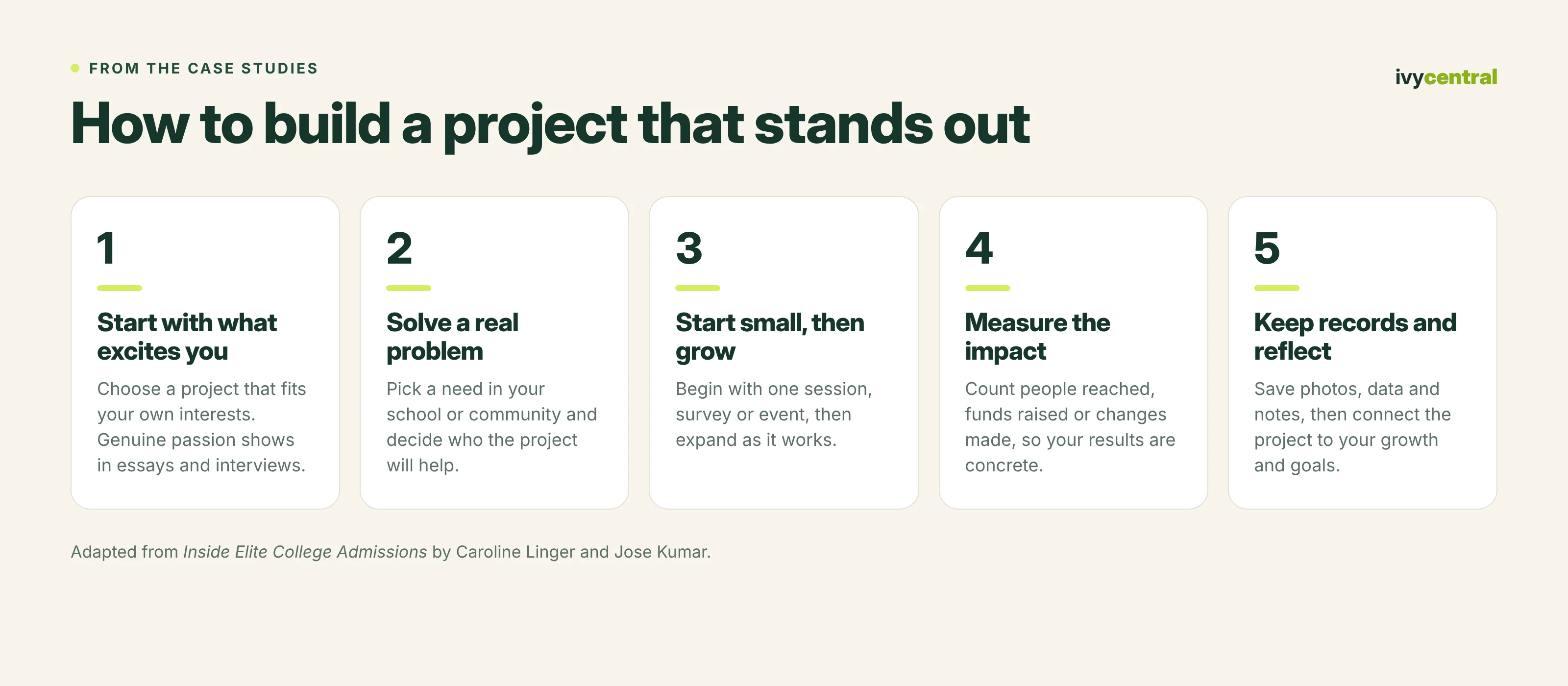
These are adapted from the book. Choose the one that fits your own interests rather than copying the student's.
| Project | What you do | How to start | How to describe it |
|---|---|---|---|
| Research on a topic that matters to you | Link a personal interest to a wider issue, such as immigration policy or technology in education | Read widely, interview people affected, write a short paper or policy brief | Your question and recommendation |
| Community arts project with a message | Write and direct a short play, compose music or create art on an issue you care about | Develop it over 1 to 2 months; perform or exhibit it for a school or community audience | Audience and response |
| Storytelling platform | Start a blog, podcast or social series on identity, global health or human rights | Publish regularly; include interviews and your own research | Episodes or posts and reach |
| Global issues forum | Host a World Perspectives Day with student talks, performances and debates on topics like migration or climate | Recruit speakers and performers; secure a venue; invite the school | Speakers, topics and attendance |
| Peer mentorship or advocacy | Support younger students academically, or campaign for better mental health resources | Recruit mentors or allies; run it for a semester | Students supported or changes won |
Students interested in global affairs may like our list of the best universities for international relations and our page on why Model United Nations helps.
Is your child a writer, artist or debater?
Creative students sometimes feel their strengths do not fit a selective application. Often they are exactly what stands out. We help them shape that into a clear story in a free strategy call.
Frequently asked questions
What ACT score did this Brown admit have?
A perfect 36, plus 5s in AP English Literature and AP Psychology.
Did the student apply Early Decision to Brown?
No. They applied in the Regular Decision round.
What was the Brown personal essay about?
How a mother's challenge to write their own stories turned a keen reader into a writer of poetry, plays and fiction.
How did the student write about Brown's Open Curriculum?
They described combining English, Biology, History, Sociology and Political Science into a course of study shaped around their interests.
Do you need to publish a book to get into Brown?
No. The books showed this student's initiative, but the strength of the application was how writing, research and leadership fitted together.
Read the other case studies
See what all ten admitted students had in common, read the Harvard case study, or see the Princeton case study.
Sources
- Caroline Linger and Jose Kumar, Inside Elite College Admissions: 10 Real-World Case Studies (2025), Case Study 9.