
This IB student was admitted to Princeton through Restrictive Early Action with an unusual blend: medical research, classical music and a third-degree black belt. They founded a self-defense program that taught hundreds of girls in rural schools, and their essays traced how martial arts and speech therapy shaped their confidence and purpose.
This is Case Study 10 from our book, Inside Elite College Admissions. It is based on a real student profile that has been adapted and fully anonymized. It shows what worked for one student; it does not guarantee any outcome.
Who was the applicant?
| Detail | Profile |
|---|---|
| Citizenship | US citizen who moved countries |
| School | Independent international school, IB Diploma Programme |
| Application | Restrictive Early Action, Princeton University |
| IB subjects | Higher Level Biology, Chemistry, Mathematics and History; Standard Level English A Literature and Spanish ab initio |
| Testing | SAT 1540 (800 Math); 5 in AP Psychology, 4 in AP Statistics |
| Recognition | National honors and a perfect score in national board examinations |
| Goal | A doctorate and a career that combines science and social impact |
For context, see our pages on Princeton's acceptance rate and what to know about Princeton, and our explainer on early action.
What made the application stand out?
Medical research
The student was selected as a fellow in a highly competitive summer research program, where they researched fecal microbial transplantation; the work was presented at a university symposium and was scheduled for a US conference. At a prestigious US university they also presented on cancer immunotherapy and T-cell reprogramming, and at an ENT center they researched rehabilitation after cochlear implants, producing a paper and poster.
A self-defense program for girls
Drawing on their own experience as a female martial artist with a third-degree black belt and national championship titles, the student founded an organization teaching self-defense and risk awareness to girls in rural schools in a developing country. It reached hundreds of girls.
Service through speech therapy
As a volunteer assistant speech therapist, they helped children improve their speech after cochlear implant surgery. They also helped digitize archival recordings.
Music and languages
The student completed national-level classical music training with distinction, founded a school music club and performed in concerts. They spoke English, French, German, Mandarin and Spanish.
What did the essays say?
The personal essay followed the student from childhood to adulthood through martial arts: moving countries, finding a home in the dojo, and being one of the few female fighters in a male-dominated space. That experience sparked their commitment to gender equality and led to the self-defense program. A Princeton supplemental essay told the story of a young child they worked with as an assistant speech therapist, whose progress from basic sounds to full sentences taught the student the value of creativity and spontaneity and changed their own confidence.
Why did it work for Princeton?
The talents looked unrelated (lab science, classical music, martial arts) until the essays connected them through one theme: helping others find their voice and strength. Research showed academic depth; the self-defense program and speech therapy showed impact. In our reading, that combination of intellectual excellence, leadership and service is what Princeton values.
What can other applicants learn from it?
- Let your own experience lead to action. Being one of the few girls in the dojo became a program for hundreds of girls.
- Pursue research seriously. A competitive fellowship, presentations and a paper showed real scientific ability.
- Find the thread between talents. Science, music and martial arts became one story about empowerment.
- Write about someone else. The speech therapy essay showed character through another person's progress.
- Adapt and keep going. Moving countries became part of the story, not an obstacle.
Five project ideas inspired by this profile
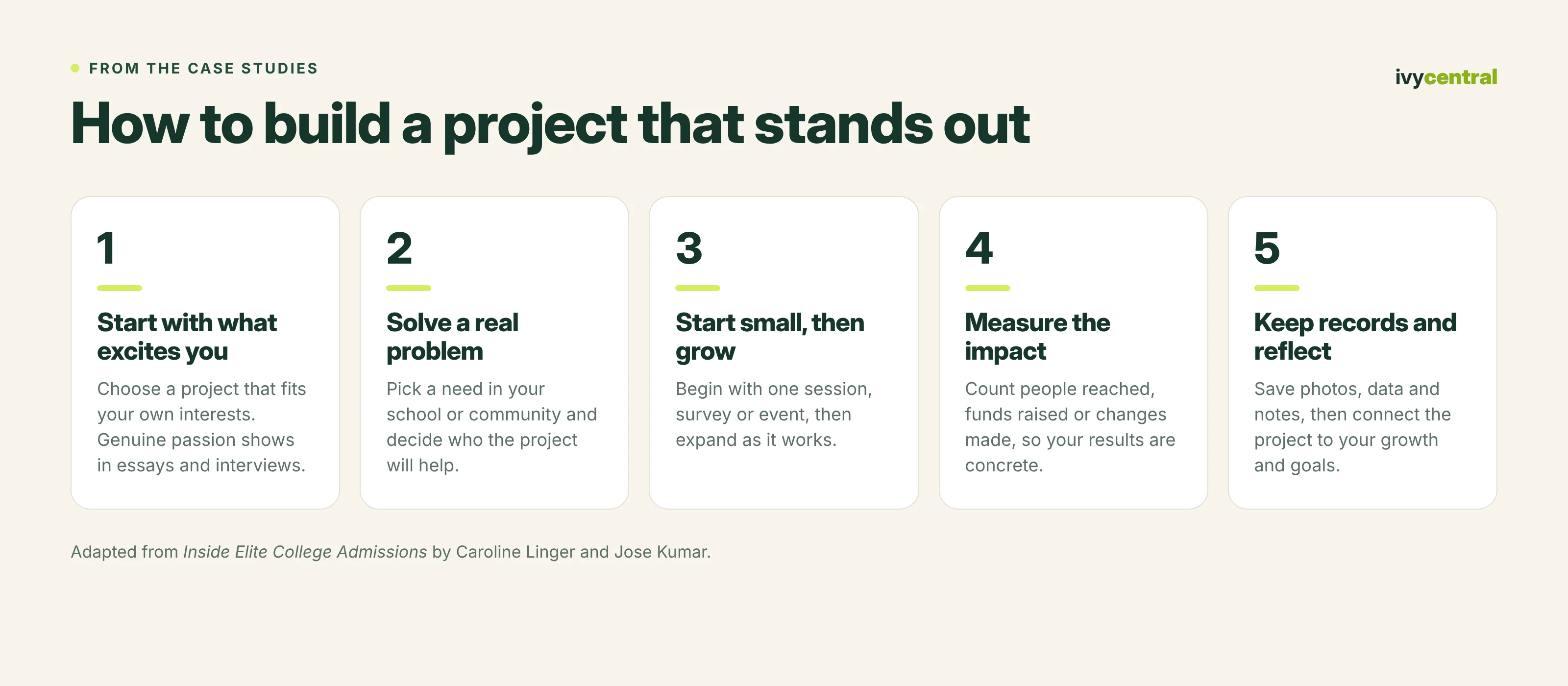
These are adapted from the book. Choose the one that fits your own interests rather than copying the student's.
| Project | What you do | How to start | How to describe it |
|---|---|---|---|
| Community research project | Study a local issue such as healthcare access or educational gaps | Survey local people; analyze the results; share recommendations with a community group | Your question, data and proposal |
| Mentorship or empowerment program | Teach a skill to a group that needs it, such as self-defense for girls, tutoring or music lessons for children with disabilities | Partner with a school or community center; run a weekly series for a term | Participants and what changed for them |
| Cultural or artistic initiative | Organize a concert series of traditional music or an art project about an issue | Recruit performers; book a venue; promote it to the community | Performances, audience and funds raised |
| Blog or podcast about your growth | Document adapting to a new culture or mastering a skill | Publish regularly for a few months | Audience and what it shows about you |
| Science or innovation challenge | Run a competition or hackathon on, for example, assistive devices or clean energy | Recruit teams and teacher mentors; host a final showcase | Teams, ideas and outcomes |
For research opportunities, see our list of summer research programs for high school students.
Does your child have talents that seem unrelated?
Students with very different interests often have a common thread they have not spotted. Finding it is how an application becomes memorable. Let us help in a free strategy call.
Frequently asked questions
Did this student apply early to Princeton?
Yes. They applied through Princeton's Restrictive Early Action plan.
What SAT score did this Princeton admit have?
1540 out of 1600, with 800 in Math.
What was the Princeton personal essay about?
Growing up through martial arts, moving countries, and being one of the few female fighters in their dojo, which led to their self-defense program for girls.
What did the Princeton supplemental essays cover?
Their extracurriculars, including martial arts and music, their summers, and a young child they helped as an assistant speech therapist.
Can an IB student at an international school get into Princeton?
Yes. This applicant studied the IB Diploma at an independent international school.
Read the other case studies
See what all ten admitted students had in common, read the Brown case study, or see the Penn case study.
Sources
- Caroline Linger and Jose Kumar, Inside Elite College Admissions: 10 Real-World Case Studies (2025), Case Study 10.