
This non-US student was admitted to Harvard in Regular Decision with a profile centered on mental health. After a friend's struggle with depression, they founded a nonprofit that teaches mental health in schools and communities. Their essays explored growing up between two cultures and how they went from doubting meditation to studying it.
This is Case Study 8 from our book, Inside Elite College Admissions. It is based on a real student profile that has been adapted and fully anonymized. It shows what worked for one student; it does not guarantee any outcome.
Who was the applicant?
| Detail | Profile |
|---|---|
| Citizenship | Non-US citizen |
| School | High school with an AP curriculum |
| Application | Regular Decision, Harvard University |
| Senior-year courses | AP European History, AP Calculus BC, AP Spanish V, AP English Language, AP Psychology, AP Human Geography, Honors Anatomy and Physiology |
| Academics | Weighted GPA 4.5, ranked 1st of 80 |
| Testing | ACT 33; 5 in AP US Government and Politics |
| Goal | Social sciences, possibly a doctorate |
For context, see our pages on Harvard's acceptance rate and what to know about Harvard. This student's ACT of 33 shows that a strong, not perfect, score can sit inside a successful application.
What made the application stand out?
A mental health nonprofit
Prompted by a friend's depression, the student founded a nonprofit that developed a mental health education curriculum and delivered it in schools, care centers and communities in several countries. They served on a state advisory committee on mental health and domestic violence awareness, created a public service announcement, and proposed mental health programs for their own school's curriculum.
Speech and debate
In original oratory, the student reached the finals of multiple prestigious competitions, and served as team captain and novice coach.
Research and curiosity
A research internship at a university medical center reflected an interest in neuroscience.
School and community leadership
As president of their Future Business Leaders of America chapter, they ran a student shop and won state and national awards. They edited the school newspaper, launched its literary magazine, played drums in the orchestra with a superior rating at a district contest, led teen hospital volunteers and supported food-insecure families.
What did the essays say?
The personal essay looked back at a childhood spent between cultures, and how that created a quiet divide: it shaped the student's friendships and led them to hide their cultural interests. The essay showed how they came to bridge those two worlds. In a Harvard supplemental essay, they described first dismissing meditation as pseudoscience because it lacked evidence, then exploring it seriously, a turn linked to their friend's mental health struggle and to the nonprofit that followed.
Why did it work for Harvard?
The application had a clear cause and real proof of it: a nonprofit, a curriculum and policy advocacy. The essays added depth, showing a student who examines their own identity and their own skepticism. In our reading, that combination of leadership, self-reflection and impact beyond school matched what Harvard looks for.
What can other applicants learn from it?
- Respond to what you see. A friend's struggle became a nonprofit, which made the cause personal and credible.
- Go from idea to system. A curriculum delivered in many places shows more than a one-off event.
- Write about identity honestly. Describing the divide, not just the resolution, made the essay real.
- Show how you think. Moving from skepticism to inquiry about meditation showed intellectual honesty.
- Excel at something competitive. Oratory finals and captaincy proved discipline and voice.
Five project ideas inspired by this profile
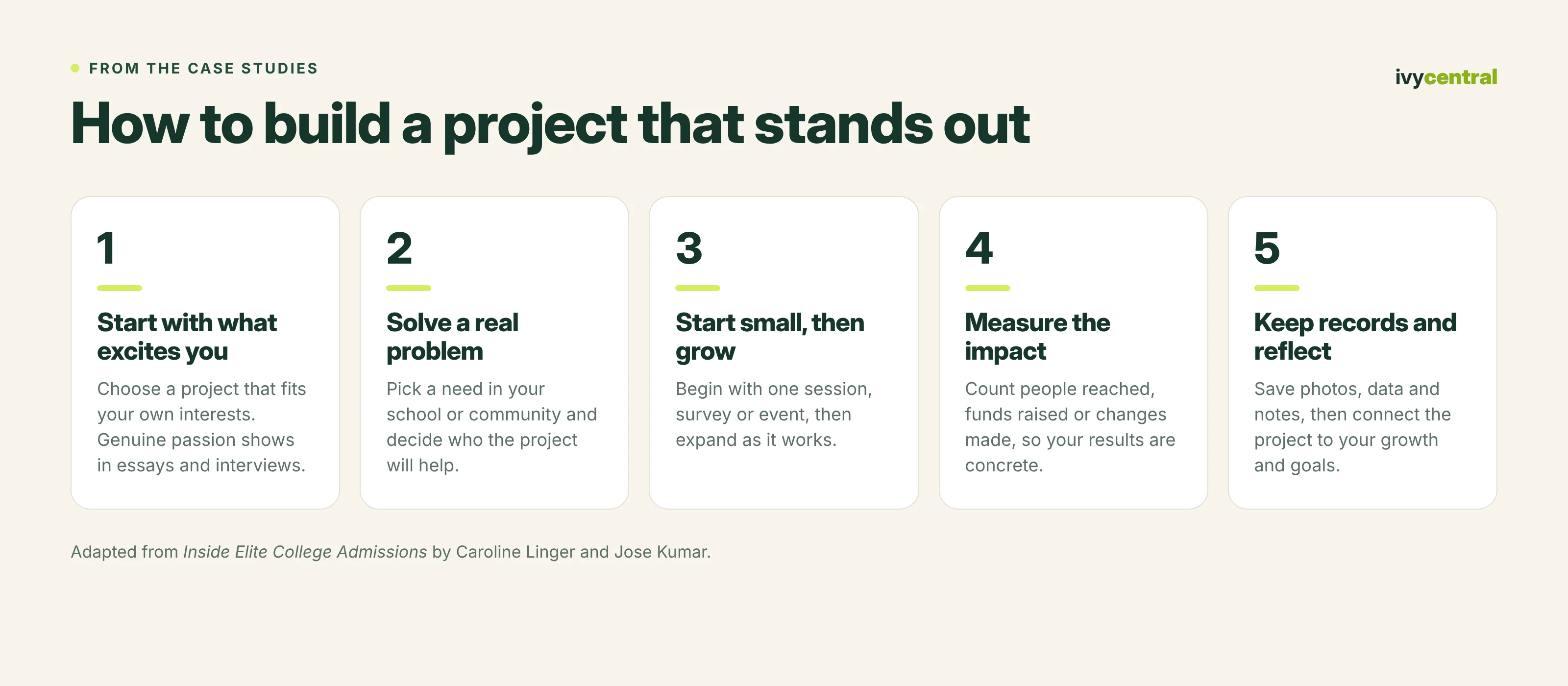
These are adapted from the book. Choose the one that fits your own interests rather than copying the student's.
| Project | What you do | How to start | How to describe it |
|---|---|---|---|
| Mental health education initiative | Design workshops or a short curriculum on stress management, such as mindfulness techniques | Work with a school counselor; pilot it with one class or club | Sessions run and students reached |
| Cultural identity project | Host a Cultural Identity Day where students share their heritage | Recruit presenters from different backgrounds; plan one event | Cultures shared and attendance |
| Competitive excellence in one passion | Commit to reaching a high level in public speaking, a sport or an art form | Enter local, then regional or national competitions; coach newer members | Results and the people you coached |
| Independent research on a social issue | Study, for example, the effect of mindfulness on stress or of cultural identity on teenagers | Run a survey; analyze the results; ask a teacher to review your write-up | Your question and finding |
| Digital platform on a global issue | Launch a blog, podcast or social campaign on mental health, identity or justice | Publish consistently for a few months; interview peers or experts | Audience and engagement |
For help putting a story like this into words, read our guide to writing college application essays.
Does your child care deeply about a cause?
A cause becomes powerful in an application when it leads to action. We help students turn what they care about into a project, and a project into an essay, in a free strategy call.
Frequently asked questions
What GPA and test scores did this Harvard admit have?
A weighted GPA of 4.5, a class rank of 1 out of 80, and an ACT score of 33.
Did the student apply early to Harvard?
No. They applied in the Regular Decision round.
Can a non-US citizen get into Harvard?
Yes. This applicant was a non-US citizen.
What was the Harvard personal essay about?
Growing up between cultures, the divide it created, and how the student learned to bridge it.
Do you need to start a nonprofit to get into Harvard?
No. What mattered here was a sustained response to a real problem; a nonprofit was this student's way of doing that.
Read the other case studies
See what all ten admitted students had in common, read the Cornell case study, or see the Brown case study.
Sources
- Caroline Linger and Jose Kumar, Inside Elite College Admissions: 10 Real-World Case Studies (2025), Case Study 8.