
This international IB student was admitted to Cornell in Regular Decision by connecting economics, psychology and their own two cultures. They ran a large online experiment on how AI in marketing changes perceived value, interned at a market research firm, and proposed a study plan combining Economics, Psychology and Philosophy in Cornell's College of Arts and Sciences.
This is Case Study 7 from our book, Inside Elite College Admissions. It is based on a real student profile that has been adapted and fully anonymized. It shows what worked for one student; it does not guarantee any outcome.
Who was the applicant?
| Detail | Profile |
|---|---|
| Citizenship | Non-US citizen |
| School | International school, IB Diploma Programme |
| Application | Regular Decision, Cornell University (College of Arts and Sciences) |
| IB subjects | Higher Level Economics, Psychology and Mathematics: Applications and Interpretation; Standard Level English, Biology and French |
| Academics | Predicted 42 out of 42 in IB subject grades; Extended Essay in Psychology |
| Goal | A career in business and consumer behavior |
For context, see our page on Cornell's acceptance rate.
What made the application stand out?
Research into consumer behavior
Under mentorship, the student designed and ran a large online experiment on how artificial intelligence in marketing affects perceived value, exploring bias and influence. At a market research firm they interviewed consumers and analyzed feedback to help shape marketing strategy for a well-known brand.
Leadership across cultures
Having lived in more than one country, the student organized a school cultural festival that blended international and local traditions. They were an elected youth council representative advocating for mental health and safety, led a student organization on Asian culture that raised funds for a nonprofit, and presided over a foundation providing health education to underprivileged girls.
Writing on global issues
Their essay on global population dynamics received a very high commendation in an international essay competition with thousands of entries. They also wrote a book about education, poverty and equality in a developing country.
Arts and sport
A trained dancer with multiple certifications, the student also played Western classical and jazz piano, earned music theory certifications and won swimming medals in freestyle and butterfly.
What did the essays say?
The personal essay described a change of mind. The student had been a committed advocate for women's rights, until a documentary challenged their assumptions and gave them a more nuanced view of inequality that included everyone. It showed intellectual honesty and a willingness to listen to opposing views. The Cornell essay then proposed an interdisciplinary course of study combining Economics, Psychology and Philosophy to understand consumer behavior, naming specific courses and faculty.
Why did it work for Cornell?
The academic interest was real and tested: an experiment, an internship and an essay competition all showed it. The cultural leadership showed who the student was outside the classroom, and the Cornell essay showed they had done their homework. In our reading, that interdisciplinary plan was a natural fit for Cornell's College of Arts and Sciences.
What can other applicants learn from it?
- Test your interest. An experiment and an internship turned an interest in consumer behavior into evidence.
- Bring your cultures together. The festival and student organization made a dual identity a strength.
- Show you can change your mind. An essay about rethinking a belief can be more powerful than one about certainty.
- Make the why-us essay specific. Naming courses and faculty showed genuine fit with Cornell.
- Write for an audience. A competition essay and a book showed the student could argue a case in public.
Five project ideas inspired by this profile
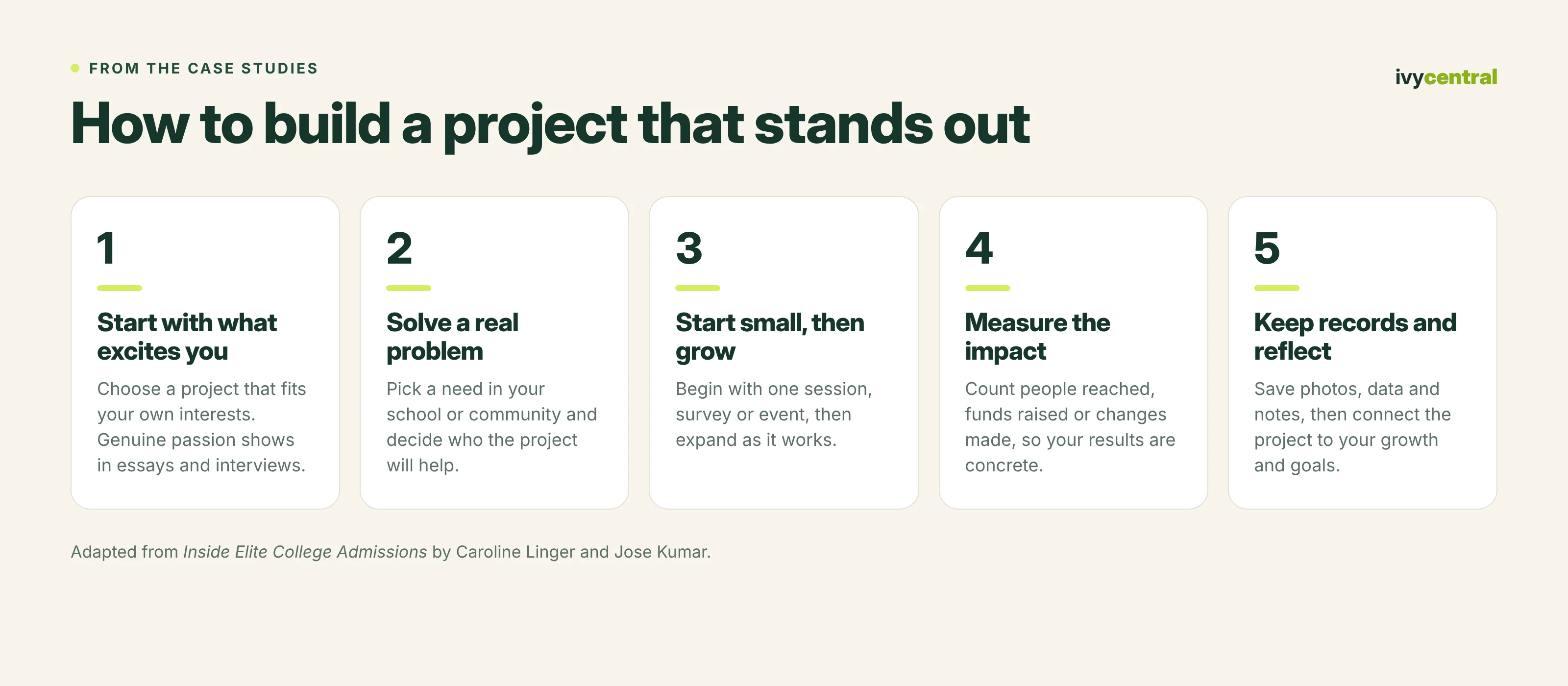
These are adapted from the book. Choose the one that fits your own interests rather than copying the student's.
| Project | What you do | How to start | How to describe it |
|---|---|---|---|
| Consumer behavior experiment | Show two versions of an ad (for example, price-focused vs exclusivity-focused) and measure which people prefer | Use free survey tools; collect responses from classmates or online; analyze the results | Your hypothesis, sample and result |
| Cultural exchange event | Host a World Cultures Day with music, food, art and performances from different backgrounds | Partner with cultural clubs and families; plan one school event | Cultures represented and attendance |
| Community service initiative | Address a local need such as tutoring, sustainability or mental health support | Choose one need; recruit volunteers; run it for a semester | People helped and the change you saw |
| Interdisciplinary blog or podcast | Explore a topic such as how psychology shapes economic choices | Publish regularly for a few months; interview a teacher or expert | Episodes or posts and audience |
| International essay competition | Write an essay that analyzes a global problem and proposes solutions | Pick a reputable competition; draft early; ask a teacher for feedback | The competition and any recognition |
For writing opportunities, see our list of writing competitions for high school students, and our advice on writing the why this college essay.
Does your child's interest cross subjects?
Students with interests in two or three fields often worry their application looks unfocused. Done well, it is a strength. We help students build that interdisciplinary story in a free strategy call.
Frequently asked questions
Can international students get into Cornell?
Yes. This applicant was a non-US citizen studying the IB Diploma at an international school.
Which Cornell college did the student apply to?
The College of Arts and Sciences, with a proposed program combining Economics, Psychology and Philosophy.
Did the student apply Early Decision to Cornell?
No. They applied in the Regular Decision round.
What was the personal essay about?
How a documentary challenged the student's views on inequality and led them to a more nuanced understanding.
What made the Cornell-specific essay strong?
It proposed a clear interdisciplinary course of study and named specific courses and faculty that matched the student's interests.
Read the other case studies
See what all ten admitted students had in common, read the Harvard case study, or see the Johns Hopkins case study.
Sources
- Caroline Linger and Jose Kumar, Inside Elite College Admissions: 10 Real-World Case Studies (2025), Case Study 7.