
This international IB student was admitted to Johns Hopkins in Early Decision with a profile built around becoming a doctor. After watching a procedure during an internship, they ordered a suturing kit and taught themselves surgical stitches. Published research on CRISPR in cancer treatment and a detailed Johns Hopkins supplement completed the picture.
This is Case Study 6 from our book, Inside Elite College Admissions. It is based on a real student profile that has been adapted and fully anonymized. It shows what worked for one student; it does not guarantee any outcome.
Who was the applicant?
| Detail | Profile |
|---|---|
| Citizenship | International applicant |
| School | International school, IB Diploma Programme |
| Application | Early Decision, Johns Hopkins University |
| IB subjects | Higher Level Mathematics, Biology and English; Standard Level Chemistry, Spanish and History |
| Extended Essay | Biology |
| Recognition | Top grades in a competitive international examination |
| Goal | Becoming a physician |
For context, see our page on Johns Hopkins' acceptance rate and our data on early decision and early action.
What made the application stand out?
Self-taught medical skills
After an internship, the student practiced surgical suturing on silicone pads and mastered several techniques. It was self-directed learning that went well beyond a typical high school activity.
Clinical exposure
At a local hospital they rotated through fields including cardiology and pediatrics, and an observership elsewhere let them shadow doctors on the wards.
Published research and a book
In a competitive academic program, the student researched the role of CRISPR in treating cancer, and the work was published. They also wrote and self-published a book on the principles of a non-traditional medical system.
Leadership in science and health
As a student leader they organized webinars connecting students with professionals, and co-led a science club and magazine that encouraged younger students to do hands-on lab work. They designed health awareness posters for underserved areas and organized health camps for children.
Dance
A trained dancer, the student earned a distinction in a regional examination, which connected them to their heritage.
What did the essays say?
The personal essay told a vivid story: watching a doctor perform a procedure, ordering a suturing kit, and teaching themselves to stitch. It was honest about early struggles, the persistence it took and the moment it finally worked. The Johns Hopkins supplement then showed real research into the university. The student wrote about the Molecular and Cellular Biology major, Hopkins' focus on undergraduate research, programs such as BioREU, and specific research areas that matched their interests.
Why did it work for Johns Hopkins?
The application was focused and believable. Every element (clinical exposure, self-taught skills, research, health education) pointed to medicine, and the essay showed the persistence behind it. In our reading, the specific, well-researched supplement and the Early Decision commitment made the student's fit with Johns Hopkins' research culture easy to see.
What can other applicants learn from it?
- Learn by doing. Teaching yourself a real skill shows initiative that grades cannot.
- Pair research with action. Publishing research and running health camps showed both thinking and doing.
- Write a specific supplement. Naming the major, programs and research areas showed genuine interest in Hopkins.
- Show persistence honestly. The essay admitted early failures, which made the success credible.
- Keep something that is yours. Dance added a cultural, personal dimension to a science-heavy profile.
Five project ideas inspired by this profile
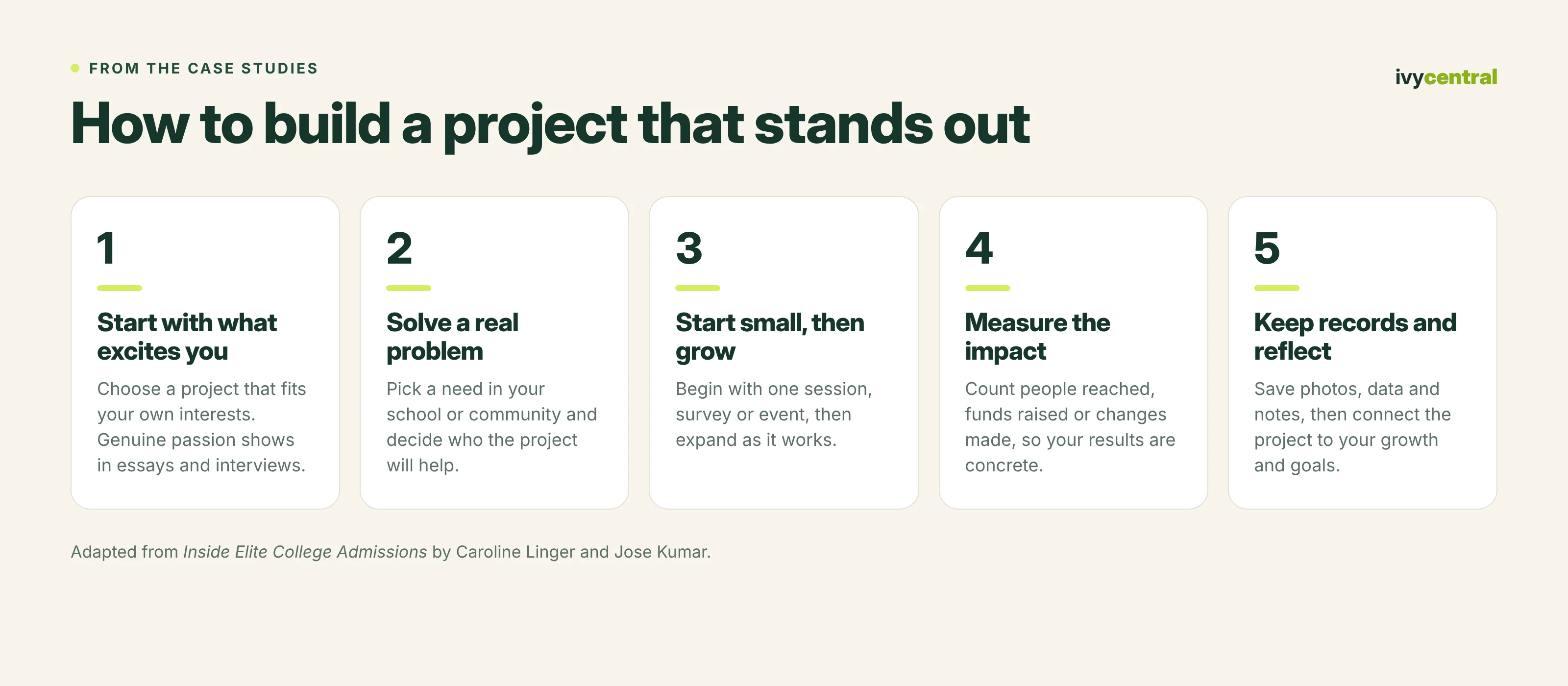
These are adapted from the book. Choose the one that fits your own interests rather than copying the student's.
| Project | What you do | How to start | How to describe it |
|---|---|---|---|
| Medical skills workshop | Learn CPR, first aid or basic wound care, then teach it to peers or younger students | Get trained through a recognized course; run a session for a club or school group | People trained and skills taught |
| Independent research review | Pick a medical topic such as gene editing or nutrition and review the published research | Read studies on free databases such as PubMed; write a short paper; ask a teacher to review it | Your topic, sources and conclusion |
| Health education campaign | Raise awareness of an issue like diabetes, hygiene or mental health, in several languages if needed | Design posters or social posts; share them through schools, clinics or community centers | People reached and where |
| Science or health club | Start a club with experiments, guest speakers or hospital visits | Recruit members; plan a semester of activities with a teacher sponsor | Members, events and what they learned |
| Cultural arts project | Teach a dance class, host a recital or create an exhibition about your heritage | Plan one event or a short series; invite your school or community | Participants and audience |
For more on this path, read our guide to college admissions for pre-med applicants and our overview of BS/MD programs.
Is Early Decision the right move for your child?
This student applied Early Decision because the fit was clear. Choosing an early school is one of the biggest strategic decisions in the process, and one we work through with every family. Talk it over in a free strategy call.
Frequently asked questions
Did this student apply Early Decision to Johns Hopkins?
Yes. They applied in the Early Decision round.
Can international students get into Johns Hopkins?
Yes. This applicant was an international student in the IB Diploma Programme.
What was the Johns Hopkins personal essay about?
Watching a doctor perform a procedure, then teaching themselves surgical suturing with a practice kit, including the struggles along the way.
What did the Johns Hopkins supplement focus on?
The Molecular and Cellular Biology major, undergraduate research at Hopkins, programs such as BioREU and specific research areas that matched the student's interests.
Do you need published research to get into Johns Hopkins?
No. Research strengthened this application, but it was one part of a profile that also included clinical exposure, service and self-directed learning.
Read the other case studies
See what all ten admitted students had in common, read the Duke case study, or see the Princeton case study.
Sources
- Caroline Linger and Jose Kumar, Inside Elite College Admissions: 10 Real-World Case Studies (2025), Case Study 6.