
This public school student was admitted to Duke in Regular Decision with a profile built around medicine: biomedical research on antimicrobial resistance and stem cells, hospital observerships, and community health work such as a vaccination rollout for over 1,000 residents. Their essay turned a small lab mistake into a lesson about precision.
This is Case Study 5 from our book, Inside Elite College Admissions. It is based on a real student profile that has been adapted and fully anonymized. It shows what worked for one student; it does not guarantee any outcome.
Who was the applicant?
| Detail | Profile |
|---|---|
| Citizenship | US citizen |
| School | Public high school |
| Application | Regular Decision, Duke University |
| Senior-year courses | Biology, Chemistry, Physics, Mathematics and English |
| Testing | SAT 1520 (790 Math, 770 Evidence-Based Reading and Writing) |
| Recognition | National finalist and a podium medal in an Olympiad |
| Goal | Becoming a physician |
For context, see our page on Duke's acceptance rate.
What made the application stand out?
Biomedical research
Under a university professor, the student studied antimicrobial resistance in hospitals and identified a plant-based molecule with potential to inhibit virulence. In a cancer hospital's research lab, they explored the wound-healing properties of mesenchymal stem cells.
Hands-on medicine
Through observerships with cardiologists, gastroenterologists and pediatricians, they observed more than 20 surgeries and consultations. In a hospital's biomedical engineering department, they designed a more efficient way to capture vital signs. They also took an MIT data science workshop and a Harvard anatomy course.
Community health leadership
The student led their school's student body and set up its first student-led clubs and societies. They founded a tutoring organization for struggling students, monitored vital signs for senior citizens and helped coordinate a COVID-19 vaccination rollout for more than 1,000 residents.
Sport, music and linguistics
A top-50 nationally ranked tennis player and team captain, the student also founded a Linguistics Circle that introduced peers to cognitive and phonetic puzzles, and played drums in a band that mixed genres.
What did the essays say?
The essay centered on a small mistake in a research lab. At first the student was frustrated; then they reflected that the cells were living things and that small details carried real consequences. The setback led to better technique, sharper focus and a personal philosophy of valuing every step in a process. It showed self-awareness and maturity, which matter for anyone planning a career in medicine.
Why did it work for Duke?
Everything in the application pointed toward medicine: research, clinical exposure, engineering a practical tool and serving community health. The essay added the personal quality behind it, care for detail. In our reading, that blend of research, service and interdisciplinary interest fitted Duke's research-driven, service-minded culture.
What can other applicants learn from it?
- Do research that answers a real question. Antimicrobial resistance and wound healing are problems patients face.
- Grow from mistakes. A lab error made a stronger essay than a lab success.
- Serve your community's health. Vaccination drives and senior care made the interest in medicine concrete.
- Stay balanced. Tennis, music and linguistics showed range beyond science.
- Get close to the real work. Observerships and a hospital internship showed the student understood what medicine involves.
Five project ideas inspired by this profile
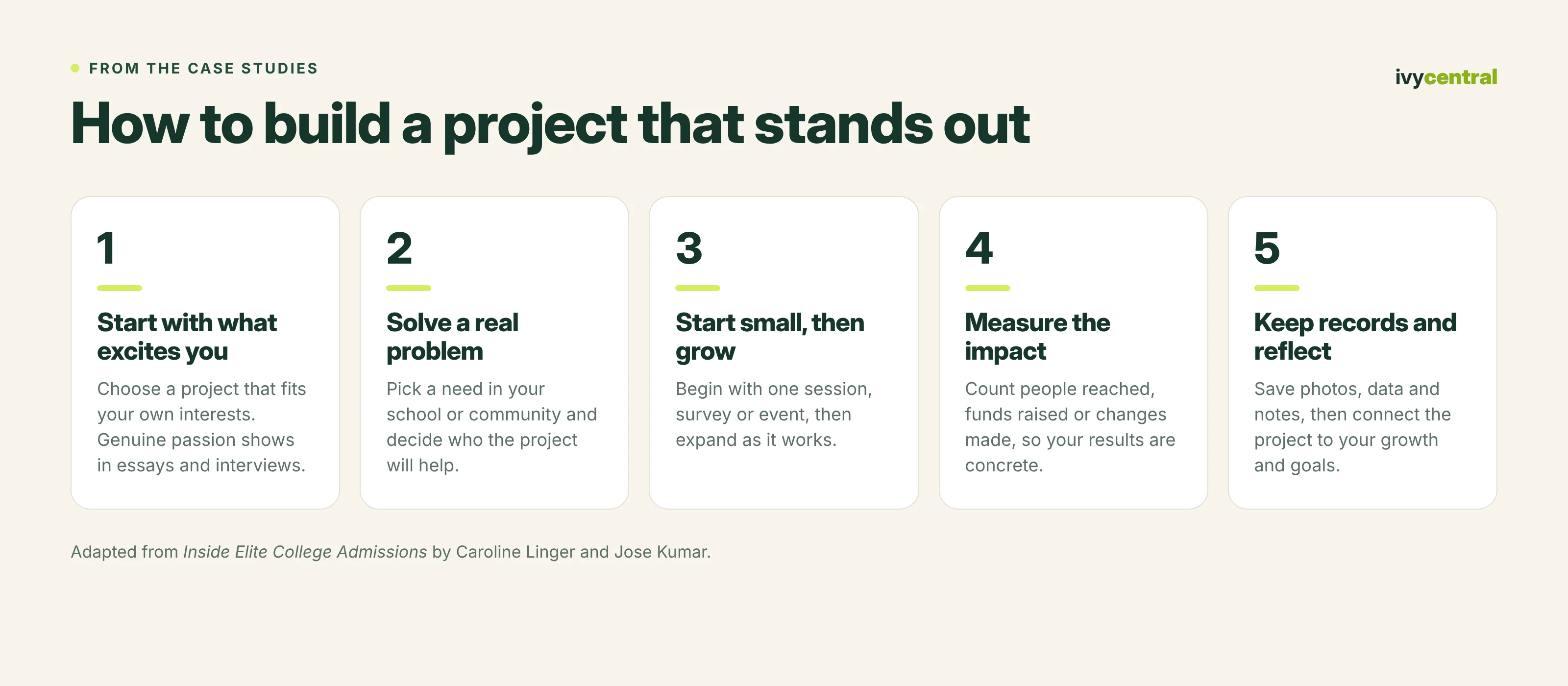
These are adapted from the book. Choose the one that fits your own interests rather than copying the student's.
| Project | What you do | How to start | How to describe it |
|---|---|---|---|
| Local health research | Study a health issue in your area, such as air quality and breathing problems or teen access to mental health support | Gather data for a month from public sources or interviews; analyze in Excel; present at a science fair | Your question, data and recommendation |
| Peer mentorship program | Pair older students with younger ones for academic or personal support | Recruit 5 to 10 mentors; run a one-semester pilot; collect feedback | Pairs matched and progress made |
| Community wellness event | Organize a health day with local providers offering checks, talks or exercise demos | Find a venue, 5 to 10 volunteers and local professionals; aim for 50+ attendees | Attendance and services provided |
| Sports science question | Test something like how warm-up length affects muscle strain | Collect data from teammates over a few weeks; share tips with your coach | What you tested and what changed |
| Cultural fusion showcase | Bring students together to blend musical or artistic traditions in a performance | Recruit performers from different backgrounds; stage one public show | Performers, traditions and audience |
For more on this path, read our guide to college admissions for pre-med applicants and our list of pre-med summer programs for high schoolers.
Is your child planning a career in medicine?
Pre-med applicants are among the most competitive. We help students show genuine commitment through research, service and a story only they can tell. Start with a free strategy call.
Frequently asked questions
What SAT score did this Duke admit have?
1520 out of 1600, with 790 in Math and 770 in Evidence-Based Reading and Writing.
Did the student apply Early Decision to Duke?
No. They applied in the Regular Decision round.
Can a public school student get into Duke?
Yes. This applicant attended a public high school.
What was the Duke personal essay about?
A small mistake in a research lab and how it taught the student the importance of precision in science and in life.
Do pre-med applicants need research?
It is not required, but in this case research, observerships and community health work together showed a real commitment to medicine.
Read the other case studies
See what all ten admitted students had in common, read the Johns Hopkins case study, or see the Yale case study.
Sources
- Caroline Linger and Jose Kumar, Inside Elite College Admissions: 10 Real-World Case Studies (2025), Case Study 5.